
A patient with two dental plans usually assumes the second one exists to pick up whatever the first one leaves behind. Most of the time that's exactly what happens — but not always. Some secondary plans are written with a non-duplication of benefits clause, and under that provision, a claim can clear primary insurance, land on the secondary plan, and still come back paying exactly $0.
That outcome isn't a processing error, and it isn't the same as a denial. It's the plan working as designed. The trouble is that most front-office teams don't find out a patient's secondary plan uses non-duplication until after treatment, when the "expected" secondary payment never shows up and the balance falls on the patient — or gets quietly written off.
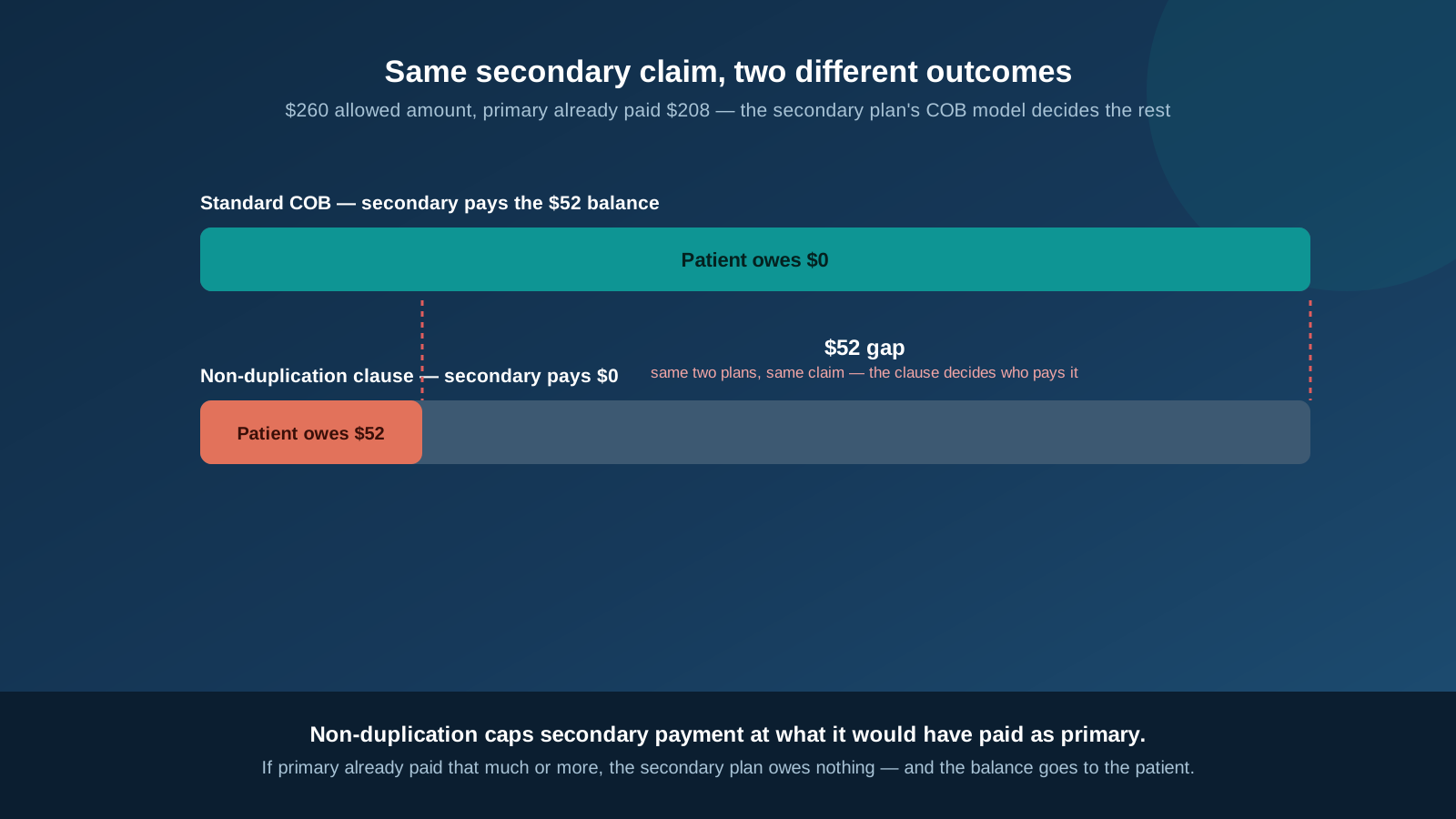
Standard COB vs. a non-duplication clause
Under standard, or "traditional," coordination of benefits, the secondary plan pays whatever balance remains after primary pays, up to the secondary plan's own maximum liability for that procedure. Coordinated this way, a patient with two active plans can often end up owing nothing at all — the two plans effectively add up to cover 100% of the allowed amount.
A non-duplication clause works differently. Before paying anything, the secondary plan first calculates a hypothetical number: what it would have paid if it had been the primary plan on that claim. It then subtracts whatever the actual primary plan already paid from that number. If the result is zero or negative — meaning primary already paid as much as or more than secondary's own primary-level benefit — the secondary plan owes nothing. This provision is sometimes labeled "non-duplication of benefits" and sometimes "carve-out," but the mechanism is the same either way.
How the math plays out on a real claim
Say a patient has a filling with a $260 allowed amount under both plans, and both plans cover the procedure at 80%. Primary pays 80% of $260, or $208, leaving a $52 coinsurance balance.
Under standard COB, the secondary plan owes up to its own maximum liability of $208 for that procedure — far more than the $52 still outstanding — so it simply pays the $52 balance and the patient owes $0.
Under a non-duplication clause, the secondary plan first asks what it would have paid as primary: 80% of $260, or $208. It then subtracts what primary already paid — also $208. The result is $0. The secondary plan owes nothing, and the patient is responsible for the full $52 coinsurance, exactly as if the secondary plan didn't exist for this claim. The two plans, the procedure, and the allowed amount are identical in both scenarios; the only difference is which COB model the secondary plan is written with.
How to catch it before it becomes a bad write-off
Because a non-duplication clause pays out differently on paper than in a patient's or front-desk team's expectations, it's easy to miscommunicate coverage before the fact and then eat the gap afterward. A few habits close that gap:
- Ask the COB question directly during secondary verification — not just whether the plan coordinates benefits, but whether it uses standard COB or a non-duplication/carve-out provision. Most payer portals and benefit summaries state it explicitly if asked.
- Don't estimate secondary payment as "whatever's left over" in a treatment plan or cost estimate until that provision is confirmed — a default assumption of standard COB will overstate what the secondary plan actually pays on plans with non-duplication language.
- Flag it in the patient's chart once identified, so every future claim for that patient is estimated correctly instead of re-discovering the same gap procedure by procedure.
- Don't treat a $0 secondary EOB as an error and resubmit or appeal it without checking the plan's COB provision first — a correctly applied non-duplication clause isn't something an appeal will overturn.
A dual-coverage claim is only fully verified once both plans' coordination model is known, not just their allowed amounts and percentages. See our dental insurance verification services for how we confirm COB provisions on both plans before treatment, not after the secondary EOB arrives.
Frequently asked questions
What is a non-duplication of benefits clause?
It's a provision, common in employer dental plans, that caps a secondary plan's payment at whatever it would have paid had it been the primary plan. The secondary plan first calculates its own hypothetical primary payment, then subtracts what the actual primary plan already paid. If that result is zero or negative, the secondary plan pays nothing.
How is non-duplication of benefits different from standard coordination of benefits?
Under standard, or traditional, COB, the secondary plan pays the remaining balance after primary pays, up to its own maximum liability — which often brings the patient's out-of-pocket cost to $0. Under non-duplication, the secondary plan's payment is capped at what it would have paid as primary, so if primary already paid that much or more, secondary pays $0 and the patient keeps the balance.
Can a practice tell in advance whether a patient's secondary plan uses non-duplication of benefits?
Usually, yes. It's stated in the plan's coordination of benefits provisions, and most payer portals or benefit summaries will note whether the plan uses a non-duplication, carve-out, or standard COB model. Asking the question directly during secondary eligibility verification, rather than assuming standard COB, is the only reliable way to know before treatment.
Does non-duplication of benefits mean the secondary plan never pays anything?
No. It only pays $0 when the primary plan's payment already meets or exceeds what the secondary plan would have paid as primary. If the primary plan pays less than that — a lower coinsurance percentage, a lower allowed amount, or a benefit exclusion — the secondary plan still pays the difference, just capped at its own hypothetical primary amount.
Don't let a dual-coverage claim become a surprise write-off
Dental Claim Professionals verifies both plans' coordination of benefits provisions upfront, so secondary payment estimates are accurate before treatment — not after the EOB arrives.
Book a Free Consultation