A new associate's start date gets circled on the calendar long before anyone checks whether every payer the practice bills has finished credentialing them. By the time day one arrives, the provider is seeing patients, but half the payer panels haven't issued an effective date yet — which means every claim billed under that provider's NPI in the meantime is sitting in a gray zone, at real risk of denial.
Credentialing delays aren't a paperwork inconvenience; they're a direct cash-flow problem. A practice that doesn't plan around payer timelines can end up with weeks or months of a new hire's production stuck in denied or unbillable claims. Understanding why credentialing takes as long as it does, and what actually happens to claims filed too early, is what makes it possible to protect that revenue instead of writing it off.
Why credentialing takes as long as it does
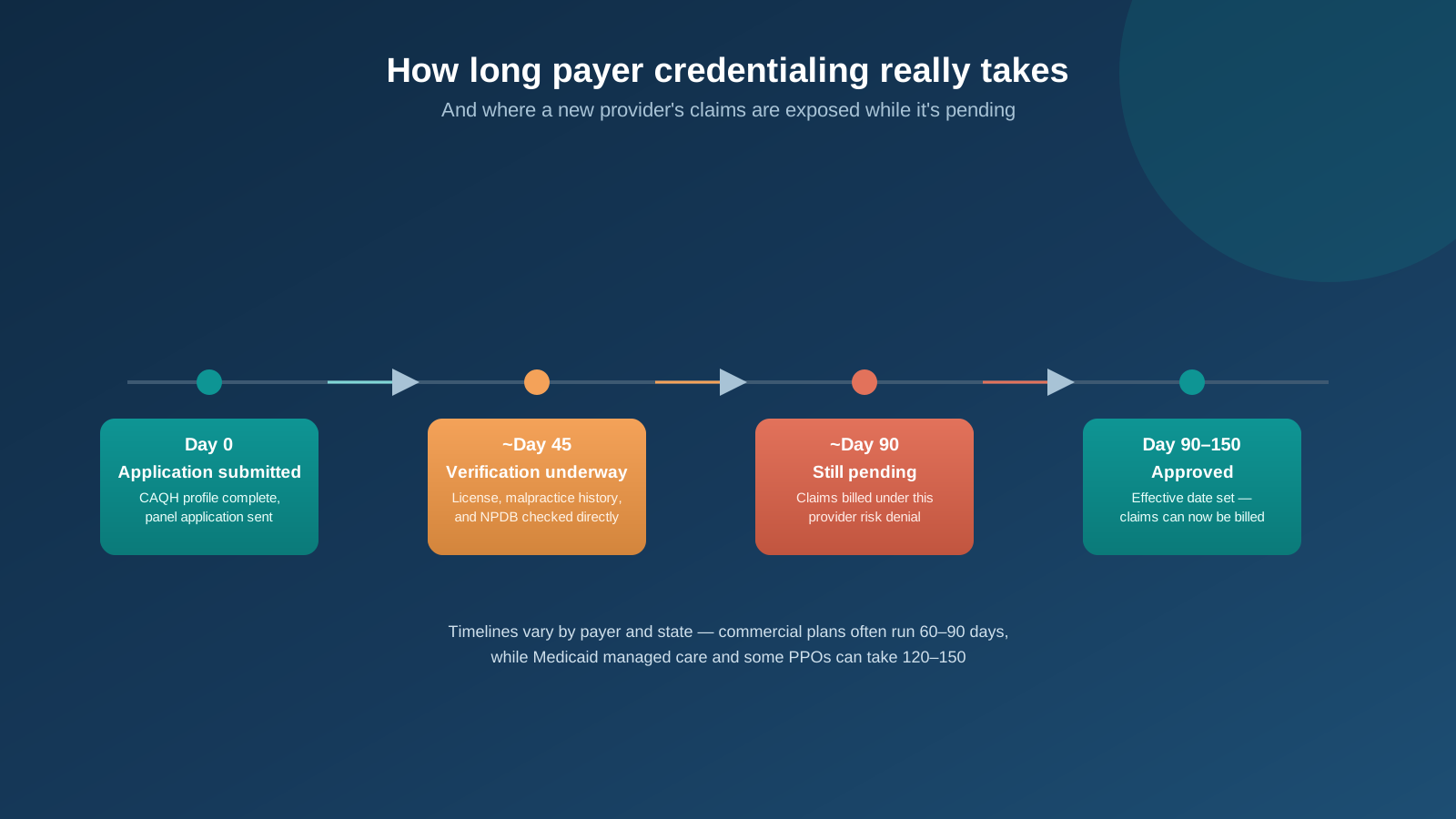
Credentialing isn't a single step — it's a sequence of verifications, and each payer runs its own version of it, even when the underlying data comes from the same source:
- CAQH profile completion. Most payers pull baseline data — license, education, work history, malpractice coverage — from a provider's CAQH profile. If that profile is incomplete, expired, or not attested within the last 120 days, the payer's process stalls before it even starts.
- Primary source verification. The payer independently confirms licensure with the state board, checks the National Practitioner Data Bank, and verifies malpractice history directly with the carrier, rather than taking the CAQH data at face value.
- Committee review and approval. Many payers only approve new providers at scheduled credentialing committee meetings, which can run monthly rather than continuously, adding weeks regardless of how quickly the file was completed.
- Contracting and effective-date assignment. Even after approval, the payer still has to finalize the provider's participation agreement and set the effective date the provider actually goes live in its system.
Commercial plans often move through this in 60 to 90 days. Medicaid managed care plans and some PPOs regularly take 120 to 150, particularly when a file has to be resubmitted for a missing document.
What happens to claims billed before the effective date
Until a payer's effective date is active, that provider doesn't exist in the payer's system as an in-network rendering provider — no matter how complete the application looks on the practice's end. Claims billed under their NPI in that window typically come back one of two ways: denied outright with a reason code like "provider not on file" or "rendering provider not eligible," or processed as out-of-network despite the practice's in-network contract, which can mean a much lower payment or none until the patient's out-of-network benefit is applied.
Both outcomes create rework: someone has to catch the denial, confirm the actual effective date, correct or hold the claim, and rebill it once the provider is active — all while the timely filing clock for that payer keeps running. A practice that doesn't track credentialing status closely can lose weeks of a new provider's production simply because claims went out before the payer was ready to receive them.
How to protect cash flow while credentialing is pending
The delay itself usually can't be shortened much, but its financial impact can be managed:
- Start applications 90 to 120 days before the provider's start date. Waiting until an offer letter is signed to begin CAQH updates and panel applications guarantees a gap between the start date and every payer's effective date.
- Track every payer's status on one log, not just the panels the front office happens to remember, since a single overlooked plan is enough to strand a chunk of claims.
- Hold claims rather than bill and hope for any payer where the effective date isn't confirmed yet — a held claim is easy to release once active, while a denied one requires an appeal or full resubmission.
- Request a retroactive effective date in writing where a payer allows it, and get the payer's written confirmation of the backdated date before rebilling anything held against it.
- Sequence new-hire scheduling around the slowest payers in the practice's mix, rather than the fastest, so the exposure window is measured in days instead of months.
A credentialing process that's tracked payer by payer, not treated as one bulk task, is what keeps a new provider's first months of production from turning into a pile of unbillable claims. See our dental credentialing services for how we manage CAQH, panel applications, and payer follow-up so new providers go live without a billing gap.
Frequently asked questions
How long does dental insurance credentialing typically take?
Most commercial dental plans take 60 to 90 days from a complete application to an approved, in-network effective date. Medicaid managed care plans and some PPOs commonly take 120 to 150 days, especially if the CAQH profile is incomplete or a payer's credentialing committee only meets monthly.
Can a new dentist see patients before credentialing is complete?
Clinically, yes, as long as the provider holds an active license. The problem is billing: until a payer finishes credentialing and assigns an effective date, that provider isn't recognized as in-network, so claims submitted under their NPI before that date are commonly denied or paid at a lower out-of-network rate.
What happens to claims billed before a provider's effective date?
They're typically denied with a reason code like "provider not on file" or "rendering provider not eligible," or they're processed out-of-network even though the practice is in-network. Either way, someone has to catch the denial, hold or correct the claim, and rebill once the effective date is active, which delays revenue and adds rework.
Can a practice get a retroactive credentialing effective date from a payer?
Some payers will backdate the effective date to the application submission date or the provider's start date, but this isn't automatic and isn't offered by every payer or plan type. It has to be requested in writing, and the practice should get the payer's confirmation of the backdated date before rebilling held claims against it.
What's the difference between CAQH and payer credentialing?
CAQH is a single online profile where a provider enters their licensure, education, malpractice history, and practice information once, and then attests to it every 120 days. Payers pull from that CAQH profile as part of their own separate credentialing process, but each payer still runs its own primary source verification and committee approval before issuing its own effective date.
Don't let credentialing delays sit on a new provider's production
Dental Claim Professionals manages CAQH, panel applications, and payer follow-up so new providers go live and start billing without a gap.
Book a Free Consultation