
The claim was coded correctly, the documentation was solid, and the patient was fully eligible on the date of service. It still comes back denied — not because anything about the treatment was wrong, but because it showed up at the carrier a few days after the filing deadline. There's no appeal that fixes a claim that arrived late, which makes timely filing one of the only denials in dental billing that's entirely preventable and completely unforgiving at the same time.
A timely filing limit is the window a plan gives a practice to submit a claim after treatment. It sounds like a simple administrative detail, but the limit isn't standardized across the industry — it's set individually by each carrier and often by each plan within that carrier — and the clock starts ticking the moment the appointment happens, whether or not anyone in the office is watching it.
Written by John Moses, founder of Dental Claim Professionals, whose team tracks filing deadlines across every plan a practice bills so a clean claim never dies from sitting too long.
Why the deadline isn't one number
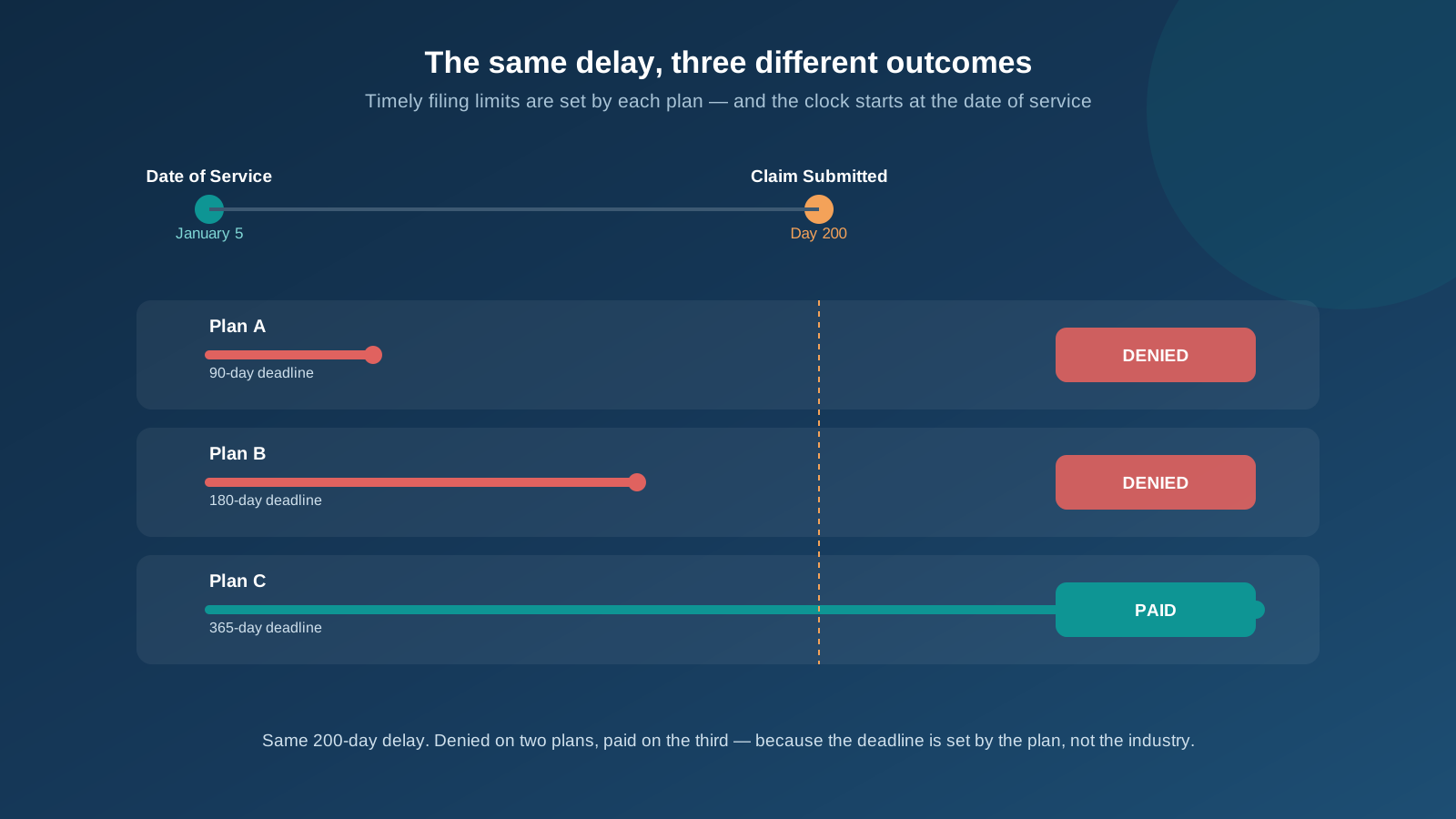
Ask five different carriers how long a practice has to file a claim and you'll likely get five different answers. Some government and managed-care plans hold to a strict 90 days. Many commercial PPO plans allow 180 days. Others extend to a full 365 days from the date of service. The number isn't set by law or by a dental association standard — it's a term of the plan's contract, which means it can vary not just carrier to carrier but plan to plan within the same carrier's book of business.
That variation is exactly what makes the limit dangerous. A billing team that mentally defaults to "we have about six months" will be right most of the time and catastrophically wrong on the plans that only allow 90 days. And because the deadline rarely appears anywhere obvious — it's buried in the plan's provider manual or contract, not on the patient's insurance card — the only reliable way to know it is to look it up per payer rather than assume.
Where claims quietly age past it
Most timely filing denials don't happen because someone forgot to bill a claim. They happen because a claim sat in a queue for a reason that felt legitimate at the time, and nobody was tracking how many days had already passed.
Held for missing documentation. A claim needs an x-ray, a narrative, or periodontal charting before it can go out, and it sits in a "waiting on doc" status while the clinical side gets around to it — sometimes for weeks.
Rebilled after a rejection. A clearinghouse rejection for a formatting or eligibility issue gets fixed and resubmitted, but the corrected claim's submission date is what the carrier sees — if that correction takes long enough, the original date of service can still fall outside the window.
Waiting on a secondary payer. Dual-coverage claims often sit until the primary EOB arrives before the secondary claim is filed. If the primary carrier is slow and the secondary plan's own filing clock started on the date of service rather than on receipt of the primary EOB, the secondary claim can expire before it's ever sent.
Batched and forgotten. Claims sitting in an unsubmitted batch in the practice management system aren't "filed" until they actually leave the building. A batch that doesn't get pushed out on schedule ages exactly like any other unfiled claim.
Proving a claim was filed on time
Even a claim that genuinely was submitted within the deadline can get denied for timely filing if the carrier's system shows a different date than the practice's records do. This is where the proof matters as much as the actual submission.
- Keep the clearinghouse report, not just the practice management log. A clearinghouse acceptance or transaction report is timestamped by a third party and is generally the strongest evidence a carrier will accept — an internal system log alone is often not enough.
- Save proof for paper claims. If a payer still requires paper submission, a certified mail receipt with a postmark is the only reliable way to prove the filing date if it's ever disputed.
- Screenshot portal confirmations. Claims filed directly through a payer portal should have their confirmation screen or reference number saved at the time of submission, not reconstructed later from memory.
- Track resubmissions separately from original submissions. If a claim is rejected and corrected, keep proof of the original submission date in case the carrier's timely filing clock should be measured from the first attempt rather than the correction.
Building a system that catches it early
The practices that never lose a claim to timely filing aren't the ones who file fastest — they're the ones who track age, not just status. A claim sitting "on hold" for documentation is still aging toward a deadline, and a dashboard that only shows submitted versus paid claims will miss it until it's too late to fix.
Build a per-payer reference table of filing deadlines rather than relying on institutional memory, flag any unsubmitted claim once it passes a set fraction of its deadline — say, half the window — so it surfaces while there's still time to gather missing documentation, and treat secondary claims awaiting a primary EOB as an aging category of their own rather than a reason to pause the clock. None of this is complicated, but it has to run every week, on every claim, without exception, because the one claim that slips through is the one that's gone for good.
Frequently asked questions
What is a timely filing limit in dental insurance?
A timely filing limit is the deadline set by a dental plan for submitting a claim after the date of service. It varies by carrier and by plan, typically ranging from 90 days to 365 days, and a claim submitted after the deadline is denied regardless of whether the treatment was covered.
When does the timely filing clock start?
The clock starts on the date of service, not the date the claim is finished being coded, not the date a predetermination was approved, and not the date a prior claim on the same treatment plan was submitted. Each date of service generally starts its own deadline.
Can a claim denied for timely filing be appealed?
Sometimes, but only with documented proof the claim was actually submitted on time, such as a clearinghouse acceptance report, a certified mailing receipt, or a portal submission confirmation showing a date inside the filing window. Without that proof, a timely filing denial is very difficult to overturn.
Does timely filing apply to secondary dental claims too?
Yes. Secondary claims have their own timely filing clock, and on many plans it starts from the date of service, not from the date the primary carrier's EOB was received — which is exactly where dual-coverage claims most often quietly age past the deadline.
What proof shows a dental claim was filed on time?
The strongest proof is a clearinghouse transaction report or acceptance confirmation showing the submission date, since it's timestamped by a third party. A certified mail receipt for paper claims or a payer portal confirmation screen also work, but a practice management system's internal claim log alone is often not accepted as proof by the carrier.
Stop losing clean claims to the calendar
Dental Claim Professionals works inside your existing practice management system — Open Dental, Dentrix, Eaglesoft, Denticon, or Softdent — to track per-payer filing deadlines, flag aging claims before they expire, and keep every claim moving before the clock runs out.
Book a Free Consultation