
Most practices watch the aging report closely, because it shows money they are owed. The credit balance report gets far less attention, even though it shows money the practice may owe someone else. Left alone, credits pile up quietly: an estimate that ran high, an insurance check posted twice, a secondary payment that arrived after the patient paid in full. By year-end, the list can run to dozens of accounts. Each one is a patient waiting on a refund, a payer that will eventually ask for its money back, or a posting error hiding the true balance. Working that list before the year closes is one of the easiest ways to tidy the books and protect patient trust.
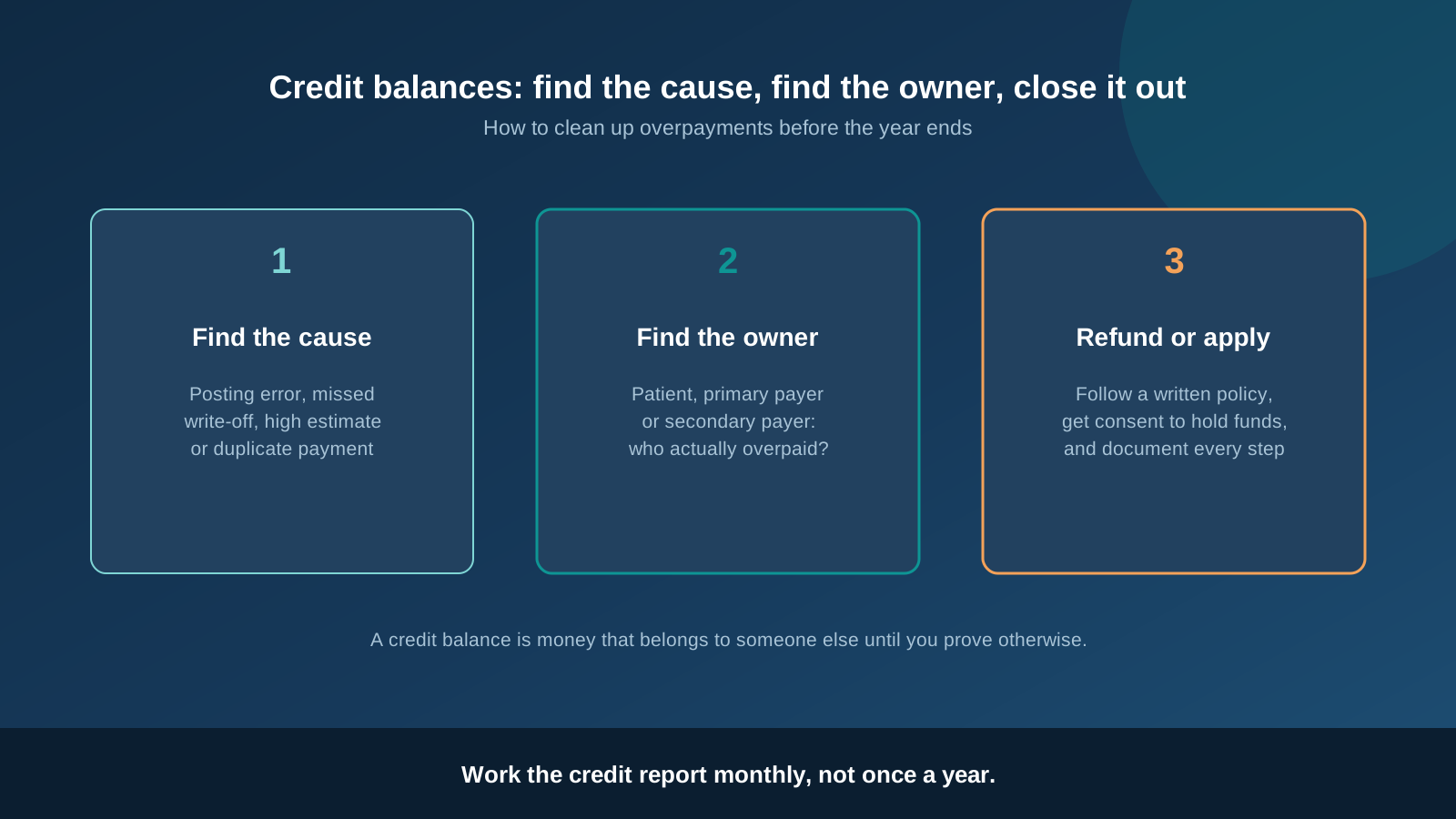
Where credit balances come from
Before refunding anything, confirm the credit is real. A large share of credit balances are not overpayments at all; they are posting errors. The usual causes:
- Missed contractual write-offs. If an in-network payment is posted without the fee schedule adjustment, the account can swing into credit once the patient pays their estimated portion.
- High estimates. The front desk collected based on an estimate, and the plan paid more than expected because the deductible was already met or the procedure was covered at a higher percentage.
- Duplicate payments. A payer reprocessed a claim and paid twice, or a patient paid by card online and again at the front desk.
- Secondary insurance. Under coordination of benefits, a secondary payment can arrive weeks after the patient has already paid what looked like their share.
- Misapplied payments. A payment landed on the wrong family member or the wrong date of service.
Pull the ledger and the EOB for each account and trace the credit to a specific transaction. If it turns out to be a posting error, correct the posting and the credit disappears. No refund is needed.
Who is owed the money: patient or payer?
Once the credit is confirmed, decide who actually overpaid. This step is where most refund mistakes happen.
- The patient overpaid when they paid more than their final responsibility after all insurance has processed. That money goes back to the patient, or to whoever paid on their behalf.
- The payer overpaid when the insurance paid more than it owed, for example a duplicate payment, a payment for a patient who was not eligible, or a primary that paid as if it were secondary. That money goes back to the payer, not the patient.
Refunding the patient for a payer's mistake is costly. When the payer finds the error, it will take the money back through a recoupment on a future check, and the practice has now paid twice. When you return money to a payer, send it with a copy of the EOB and a short note naming the patient, date of service and reason, and keep a copy of everything.
A written refund policy keeps it consistent
Credit balances get handled inconsistently when the decision depends on who happens to be working that day. A one-page policy fixes that. It should cover:
- Review cadence. Run the credit balance report monthly, not once a year.
- Refund timeline. Set a target, commonly 30 to 60 days after a credit is confirmed. Payer contracts and some state laws set their own deadlines for returning insurance overpayments, so follow whichever is shorter.
- Holding credits. Only apply a credit to future treatment when the patient agrees and the agreement is documented. Holding credits by default is not a policy.
- Approval. Require a second person to approve refunds over a set amount.
- Undeliverable refunds. Track uncashed or returned checks. After enough time, state unclaimed property laws may require you to report and remit them, so confirm the rules with your accountant.
When a patient is owed money, tell them promptly. A quick call or letter that says "your insurance paid more than we estimated, and here is your refund" builds more trust than almost any other billing conversation.
Bottom line
A credit balance is money that belongs to someone else until you prove otherwise. Trace each one to its cause, fix posting errors, return payer overpayments to the payer and patient overpayments to the patient, and put the process in writing so it happens every month. If your team would rather not spend December untangling old ledgers, our insurance billing services handle payment posting, reconciliation and refunds for you.
Frequently asked questions
What causes a credit balance on a dental patient account?
The most common causes are an estimate that collected more than the patient's actual portion, an insurance payment posted without the contractual write-off, a duplicate payment from a patient or payer, and a secondary payer paying after the patient already paid in full.
Can we keep a patient credit balance for future treatment?
Only with the patient's informed agreement. Tell the patient the amount and offer a refund; if they ask you to hold it for scheduled treatment, document that request. Do not hold credits indefinitely by default.
Should an insurance overpayment be refunded to the patient?
No. If the credit was created by a payer paying more than it owed, the refund goes back to that payer, usually with a copy of the EOB and a short explanation. Refunding the patient instead can leave the practice owing the money twice.
How quickly should credit balances be refunded?
Set a written target, commonly 30 to 60 days after the credit is confirmed. Payer contracts and some state laws set their own deadlines for returning insurance overpayments, so check those and use the shorter timeline.
What happens to refunds we cannot deliver?
Uncashed or undeliverable refunds may eventually be considered unclaimed property under state law, which can require the practice to report and remit them to the state. Track them and confirm your state's rules with your accountant.
Clean ledgers, every month
Dental Claim Professionals posts payments accurately and resolves credit balances before they pile up.
Book a Free Consultation