
Tooth-colored fillings are the everyday workhorse of restorative dentistry, and the claims look simple: a tooth, a few surfaces, one code. Yet composite fillings generate more patient balance disputes than almost any other routine service, because many plans pay a posterior composite at the lower amalgam rate and leave the patient with the difference. Getting the coding right and setting expectations up front keeps both the claim and the patient relationship healthy.
Code by tooth type and number of surfaces
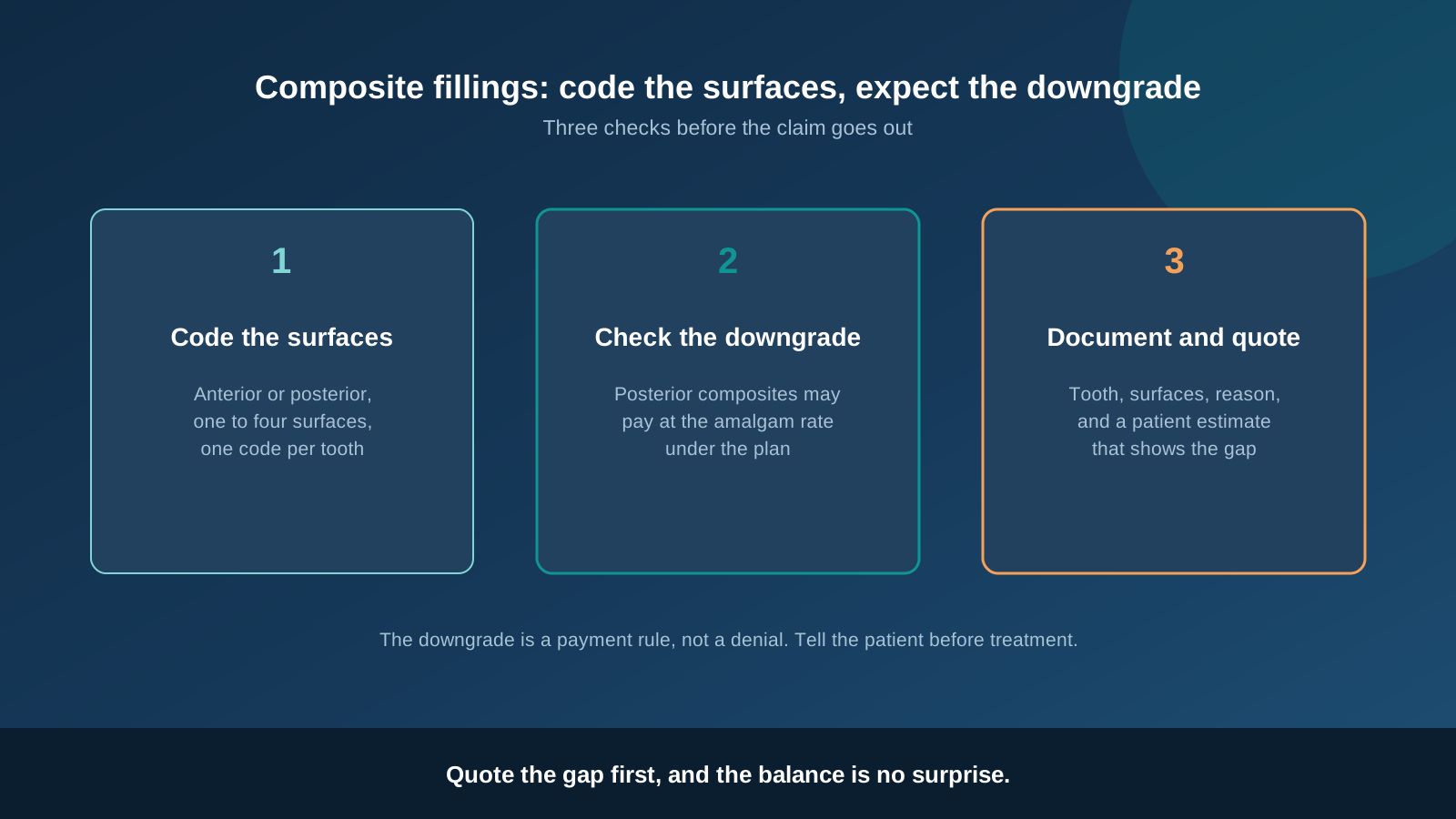
CDT separates resin-based composite fillings by whether the tooth is anterior or posterior and by how many surfaces are restored.
- D2330 to D2335: anterior composites. One, two, three, and four or more surfaces, or involving the incisal angle.
- D2391 to D2394: posterior composites. One, two, three, and four or more surfaces.
Count surfaces on a single tooth and report one code per tooth. Two separate fillings on different surfaces of the same tooth are billed as one multi-surface restoration, not as two single-surface codes. Reporting them separately is a form of unbundling and invites a recoupment later. Bonding agents, liners, etching and polishing are included in the filling, so do not bill them separately.
Plan for the amalgam downgrade
Many plans apply an alternate benefit clause to posterior composites. The plan allows the fee for the equivalent amalgam (D2140 to D2161) and pays its percentage of that smaller amount, and the patient owes the rest. Because the practice is still contracted to the original fee, whether the difference can be billed to the patient depends on the network agreement and state rules, so confirm before quoting. Anterior composites are usually paid in full because there is no amalgam equivalent.
The downgrade often appears on the EOB as a reduced allowance with a remark code rather than a denial, which is why it is easy to misread as a mistake. Treat it as a payment rule and compare it to the plan's stated limits. Some plans also limit replacement of an existing restoration to once every two to five years, so review frequency limitations when a filling is being redone on the same tooth.
Document each surface and quote the gap
Record the tooth number, each surface treated, the reason for treatment and the material used. A periapical or bitewing showing the lesion is the best support, and most plans only ask for it when a claim is questioned or a replacement is being reviewed. For a complex case, add a short note as described in our claim attachments and narratives guide.
Then build the patient estimate from the amalgam allowance, not the composite fee, and show the patient the gap in writing before treatment. Sharing that number in advance turns a surprise bill into an informed choice and makes collection at the visit far easier.
Bottom line
Composite billing comes down to three habits: code the surfaces and tooth type accurately, anticipate the downgrade on posterior teeth, and communicate the patient portion before the work is done. If your team would rather not chase these balances, our insurance billing services handle verification, estimates and follow-up.
Frequently asked questions
Why did insurance pay less for a posterior composite?
Many plans use an alternate benefit clause and pay the composite at the amalgam rate. The plan pays its percentage of the lower fee, and the patient is responsible for the difference where the contract allows.
Can I bill two codes for fillings on the same tooth?
No. Report one code per tooth based on the total number of surfaces restored. Billing separate single-surface codes for the same tooth is unbundling and may be recouped.
Can I bill bonding or a liner separately?
Generally no. Bonding, etching, liners and polishing are considered part of the restoration and are included in the filling code.
Are anterior composites also downgraded?
Usually not. Anterior teeth have no amalgam equivalent, so most plans pay anterior composites under the standard basic or major restorative benefit.
Do I need to send an x-ray with a filling claim?
Rarely for a first-time filling. Plans may request radiographs when a restoration is replaced, when frequency is in question or when the claim is audited, so keep dated images available.
Stop absorbing filling downgrades
Dental Claim Professionals checks alternate benefit rules before treatment and builds accurate patient estimates.
Book a Free Consultation