
More practices are going out of network with one or more PPOs, usually because a fee schedule stopped covering the cost of care. Open enrollment season adds to it: every November and December, patients switch employer plans and arrive in January with a carrier you no longer participate with. Out-of-network billing is not harder than in-network billing, but it works differently. There is no contracted fee to write down to, the plan decides its own allowance, and the check may not even come to your office. Practices that handle these claims the same way they handle PPO claims end up with surprised patients and growing balances.
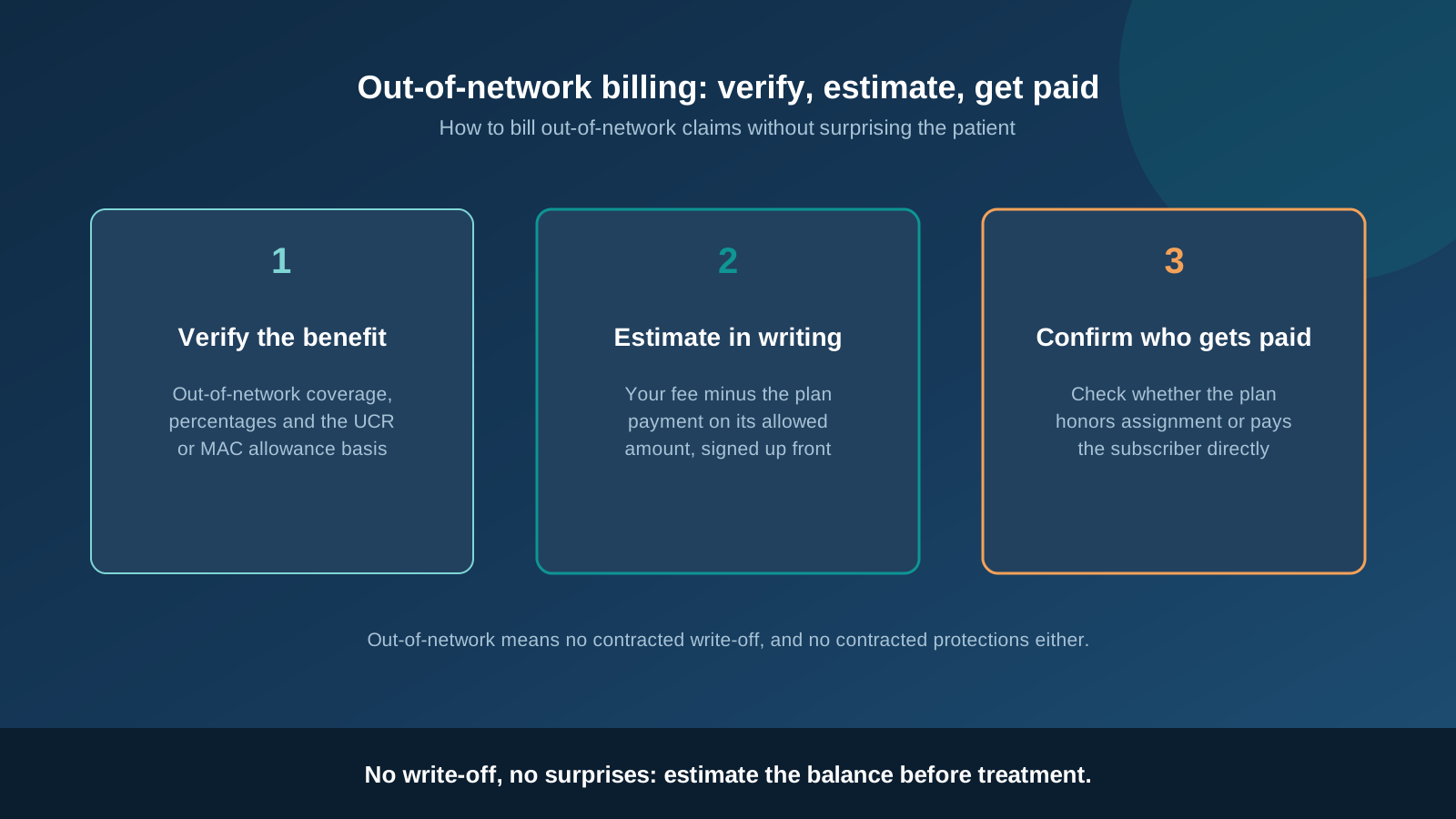
How plans pay out-of-network claims
When you are in network, the plan pays a percentage of your contracted fee and you write off the difference. Out of network, the plan pays a percentage of its own allowance, and the allowance is rarely your full fee. Plans set that allowance in one of three ways:
- UCR (usual, customary and reasonable). A maximum fee for your area, often drawn from a commercial fee database at a set percentile. Two plans from the same carrier can use different percentiles.
- MAC (maximum allowable charge). A fixed allowance schedule the plan publishes or discloses on request.
- In-network fee schedule. Some plans simply pay out-of-network dentists as if they were in network, which leaves the largest gap for the patient.
Coverage can also change out of network. Some plans apply a lower percentage, a separate deductible, or a separate annual maximum, and some HMO and EPO-style plans pay nothing at all outside the network. Ask about all of this during eligibility verification, not after the claim comes back.
Balance billing and the written estimate
Because there is no participation agreement, the patient is usually responsible for the difference between your fee and the plan's payment. That difference is the balance bill, and it is legitimate, but it should never be the first time the patient hears about it.
Build the estimate from the allowance, not your fee. If your fee for a crown is $1,400, the plan's UCR is $1,100 and it pays 50%, the plan pays $550 and the patient owes $850, not the $700 a quick "half of your fee" estimate would suggest. When the allowance is unknown, a predetermination on major work gives you a real number before treatment.
Put the estimate in writing and have the patient sign it. A good out-of-network estimate shows the office fee, the expected plan payment, the patient's expected balance, and a short line stating that the final amount depends on how the plan processes the claim. A few cautions:
- Check state law. Some states limit balance billing for certain plan types or require specific disclosures. Confirm the rules where you practice.
- Do not routinely waive balances. Writing off the patient's portion to "match" an in-network price can be viewed as misstating your fee to the payer. Offer a cash or membership plan option with clear terms instead.
Confirm who the plan will pay
Out-of-network claims carry a risk in-network claims rarely do: the payment may go to the subscriber. Some carriers, and many self-funded employer plans, pay the patient directly even when a signed assignment of benefits is on file. If the check goes to the patient, your office becomes a collector chasing money that has already been spent.
Ask during verification whether the plan honors assignment for out-of-network providers. If it does not, collect the full fee at the visit and give the patient a completed claim to submit, or file it for them and let the reimbursement go to them. Either way, the patient knows up front where the money is going.
Bottom line
Out-of-network billing works when the patient understands their balance before treatment. Verify the out-of-network benefit and allowance basis, estimate from the allowance in writing, and know whether the plan will pay you or the patient. If your practice is leaving a PPO and wants a clean transition, our insurance billing services handle verification, estimates and claim follow-up for in-network and out-of-network patients alike.
Frequently asked questions
Can an out-of-network dentist balance bill the patient?
Generally yes. Without a participation agreement there is no contracted fee to write down to, so the patient can be billed the difference between the office fee and what the plan pays. Some state laws and some plan types limit this, so confirm the rules that apply to your patients.
What is a UCR fee in dental insurance?
UCR stands for usual, customary and reasonable. It is the maximum amount a plan will consider for a procedure when the dentist is out of network, usually set by the payer from a fee database for your area. Some plans use a maximum allowable charge (MAC) or the in-network fee schedule instead.
Why did the insurance pay the patient instead of our office?
Some carriers, and many self-funded employer plans, pay out-of-network benefits to the subscriber even when an assignment of benefits is on file. Ask during verification who the plan pays so you can collect at the visit if the check will go to the patient.
Do out-of-network patients pay more than in-network patients?
Usually, because the plan's allowance is often lower than the office fee and there is no write-off. Some plans also pay a lower coverage percentage or apply a separate deductible out of network.
Should we waive the patient's balance to stay competitive?
No. Routinely waiving copays or balances can be treated as misrepresenting the fee to the payer and may violate the plan contract or state law. Offer a cash or membership plan option instead, with clear terms.
Going out of network without losing collections
Dental Claim Professionals verifies out-of-network benefits and builds estimates patients can trust.
Book a Free Consultation