
Silver diamine fluoride (SDF) has moved from a pediatric specialty to an everyday tool for children, older adults and patients who cannot sit for a restoration. It is quick, cheap and evidence-based. The billing is less tidy. Practices code SDF as fluoride, report it once per visit instead of per tooth, or apply it on the same day as a filling and wonder why the claim came back denied. A little structure up front fixes most of that.
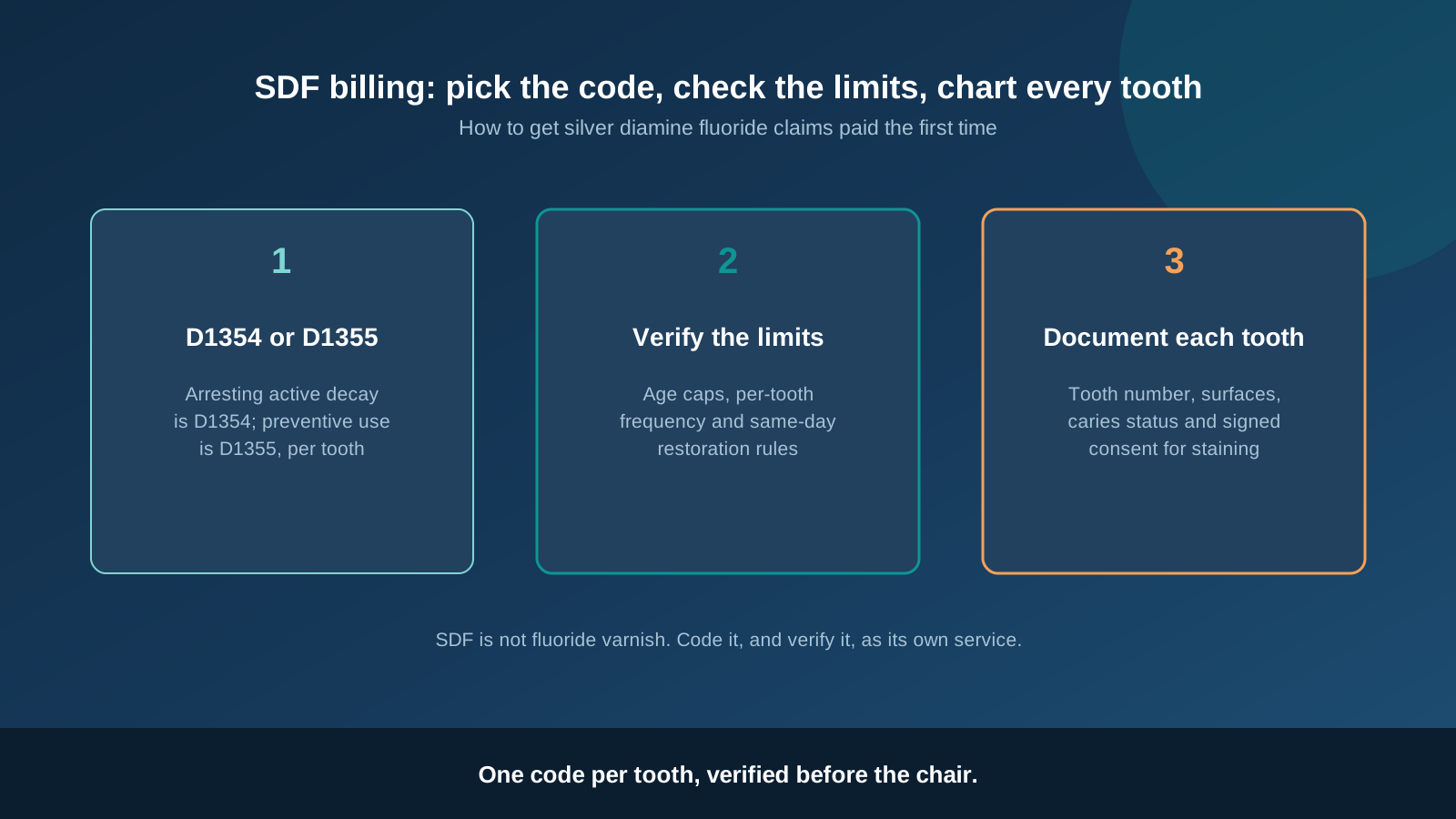
Choosing the code: D1354 versus D1355
There are two medicament codes, and the difference is the reason for treatment, not the product in the bottle.
- D1354, application of caries arresting medicament, per tooth. Use it when SDF is applied to stop an active carious lesion. The tooth has decay, and the goal is to arrest it.
- D1355, caries preventive medicament application, per tooth. Use it when a medicament is applied to a tooth without an active lesion, for prevention. Coverage for D1355 is far less common, so verify before assuming it will pay.
Both codes are per tooth. Each treated tooth gets its own line with a tooth number, the same way sealants are reported with D1351. A single line with a quantity of four is a common reason for a rejection. And SDF is never D1206 or D1208; those codes describe full-mouth topical fluoride and pay under different rules.
Payer limits to check before the appointment
SDF coverage varies more than most preventive services, so verification should ask specific questions rather than just "is D1354 covered?"
- Age limits. Many commercial plans and Medicaid programs restrict D1354 to children, often under a set age. Some plans cover adults with high caries risk; others do not cover adults at all.
- Frequency per tooth. Typical limits are one or two applications per tooth per year, sometimes with a lifetime maximum per tooth. Because SDF often needs a second application within a year, the frequency limitation is the rule most likely to trigger a denial on a recall visit.
- Same-day restorations. Many payers deny D1354 when a restoration is placed on the same tooth on the same date, treating the medicament as part of the filling. If SDF is used as a liner under a restoration, it generally is not billed separately.
- Same-day fluoride. Some plans pay both D1354 and fluoride varnish on the same day; others pay only one. Know which before the patient leaves.
Build these questions into your eligibility verification template so the front desk asks them every time. When a limit means the patient will owe for some teeth, say so up front with a written estimate.
Documentation that supports the claim
Payers that review D1354 want to see that the tooth had an active lesion and that the service was performed on that specific tooth. The clinical note should include:
- The tooth number and surfaces treated, matching the claim lines.
- The caries finding and risk assessment that supports arresting treatment.
- Signed informed consent. SDF permanently stains decayed tooth structure black, and patients or parents need to agree to that in writing.
- Intraoral photos where possible, which double as evidence if the claim is reviewed or appealed.
Note the plan for follow-up too, whether that is a reapplication, a monitoring interval or a later restoration. It explains a repeat application before the payer has to ask.
Bottom line
SDF is one of the simpler services in dentistry, and it should be one of the simpler claims. Use D1354 for arresting decay and D1355 for prevention, report each tooth on its own line, verify age, frequency and same-day rules before the visit, and keep consent and photos in the chart. If your team would rather spend that time with patients, our insurance billing services handle verification, claims and follow-up for you.
Frequently asked questions
What CDT code is used for silver diamine fluoride?
Use D1354 when silver diamine fluoride is applied to arrest an active carious lesion. Use D1355 when a medicament is applied to prevent caries on a tooth without an active lesion. Both are reported per tooth.
Can D1354 be billed with fluoride varnish on the same day?
Often yes, because D1206 is a full-mouth service and D1354 is per tooth, but some plans will not pay both on the same date. Check the plan's policy before the visit and tell the patient if one may be their responsibility.
Will insurance pay for SDF and a filling on the same tooth?
Many payers deny D1354 when a restoration is placed on the same tooth the same day, treating the medicament as part of the restoration. If SDF is used as a liner under a filling, it is usually not separately billable.
How often can D1354 be billed?
It depends on the plan. Common limits are one or two applications per tooth per year, sometimes with a lifetime cap and an age limit. Verify frequency per tooth, not per patient.
Do we need consent before applying silver diamine fluoride?
Yes. SDF permanently stains treated decay black, so record informed consent that covers the staining, ideally with a signed form and a photo of the treated teeth.
Get preventive claims paid the first time
Dental Claim Professionals verifies limits before the visit and follows up on every claim.
Book a Free Consultation