
A seven-year-old loses #K to decay months before #20 is due to erupt. Without something holding the space, the neighboring teeth drift and the permanent premolar comes in blocked or crooked. A space maintainer is a small, inexpensive appliance, but its claims get denied surprisingly often: the wrong code for the design, a per-tooth claim on a per-quadrant code, a patient who aged out of coverage, or a re-cement billed as a new appliance. Getting these right protects a reliable line of pediatric revenue and keeps parents from surprise bills.
Choosing the code
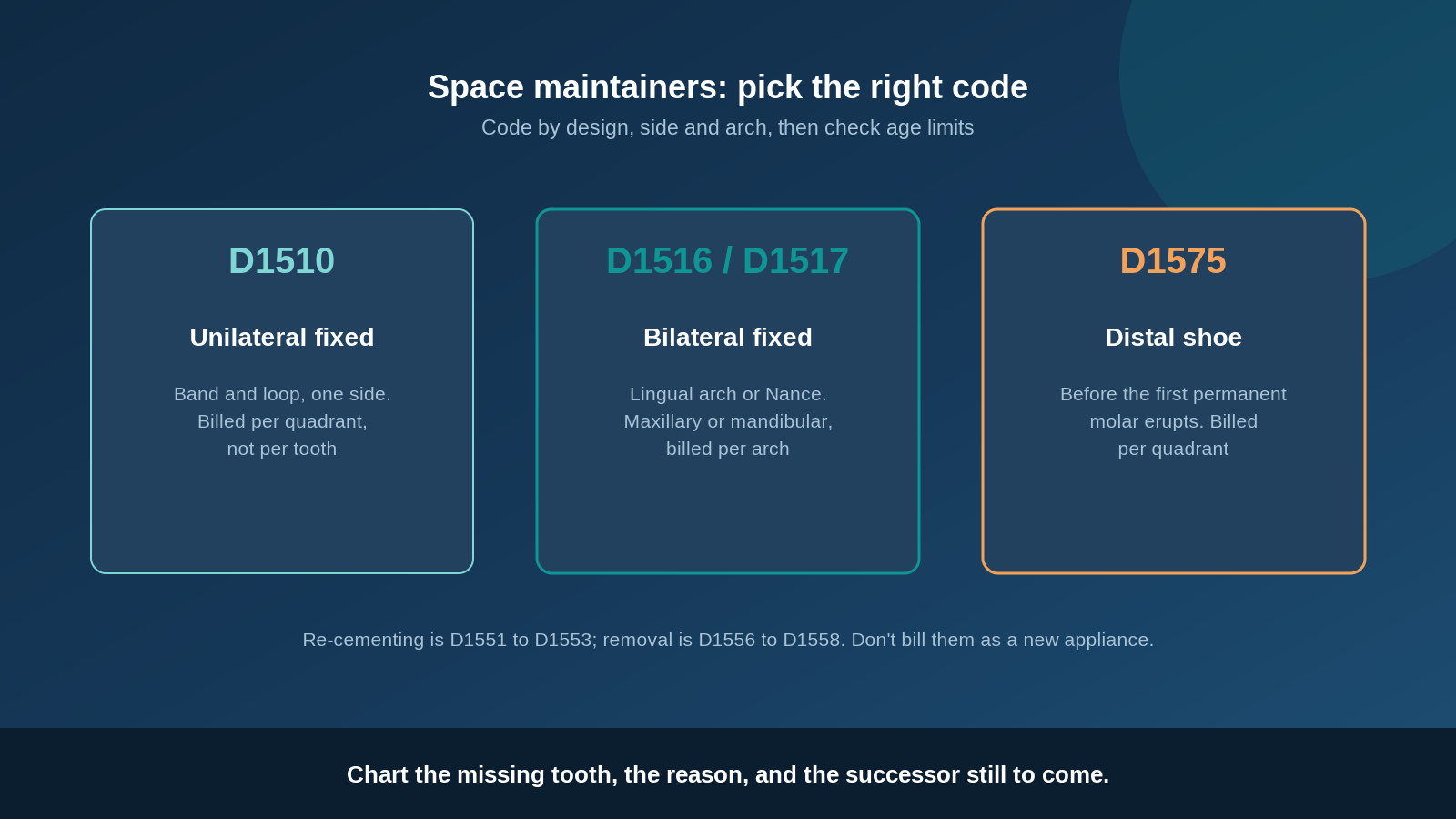
Space maintainer codes describe the appliance design and how much of the mouth it covers, not the tooth that was lost.
- D1510, fixed unilateral, per quadrant. The classic band and loop or crown and loop holding space on one side. One unit per quadrant.
- D1516 and D1517, fixed bilateral. A lingual holding arch (D1517, mandibular) or a Nance or transpalatal appliance (D1516, maxillary) holding space on both sides of one arch. One unit per arch.
- D1520, D1526 and D1527, removable. Removable unilateral (per quadrant) and bilateral (maxillary or mandibular) designs, used less often but coded the same way.
- D1575, distal shoe, per quadrant. Placed after early loss of a primary second molar, before the first permanent molar erupts, to guide it into position. It isn't a substitute for D1510 once the permanent molar is in.
If two quadrants on the same arch need holding, a single bilateral appliance is usually expected. Billing two D1510s on the same arch invites a downcode or a request for the reason a bilateral design wasn't used.
Why these claims get denied
- Age limits. Many plans cover space maintainers only under a set age, commonly 14 to 19. A patient who just crossed it gets a denial. Confirm during verification.
- Missing tooth information. Payers want to know which primary tooth is missing and that a successor is coming. Claims without the tooth, quadrant or arch, or with a successor that is congenitally missing, get held or denied.
- Re-cementation and removal. A loose band and loop that's re-cemented is D1551, D1552 or D1553, and removal is D1556, D1557 or D1558. Many plans don't pay either when the same office placed the appliance within six months or treat removal as included in the original fee. Billing a new D1510 for a re-cement is a fast route to a recoupment.
- Replacement frequency. Some plans allow one appliance per quadrant per lifetime. A lost or broken appliance may be the patient's responsibility, so set expectations before remaking it.
- Anterior space. Space maintenance for lost primary incisors is often excluded or reviewed as cosmetic. A predetermination is worth it here.
What to document
- The lost tooth and why: extraction for decay, trauma or premature exfoliation, with the date.
- A radiograph showing the permanent successor present and not yet erupting.
- The appliance design and the abutment teeth it's banded or bonded to.
- The quadrant or arch on the claim, matching the code's unit of service.
A short narrative handles most reviews: "#K extracted 10/14/26 due to non-restorable caries; #20 present on PA, not erupting; band and loop D1510 placed, banded to #L."
Bottom line
Space maintainer claims get paid when the code matches the appliance design and its unit of service, the patient is within the plan's age limit, and the chart shows a missing primary tooth with a successor on the way. Code re-cements and removals with their own codes, and check frequency rules before remaking a lost appliance. If your pediatric or family practice wants help keeping these claims clean, our insurance billing services cover verification, coding review and appeals.
Frequently asked questions
Are space maintainers billed per tooth or per quadrant?
Per quadrant or per arch, not per tooth. D1510 and D1575 are reported per quadrant, so the claim lists the quadrant (or the tooth being held for, if the payer asks). D1516 and D1517 cover a whole maxillary or mandibular arch.
Does dental insurance cover space maintainers?
Most pediatric and family plans cover them, often under basic services, but many limit coverage to children under a certain age, commonly 14 to 19, and to replacement of prematurely lost posterior primary teeth. Check the age limit and any once-per-lifetime or once-per-quadrant rule during verification.
How do I bill re-cementing a space maintainer?
Use D1551 (maxillary bilateral), D1552 (mandibular bilateral) or D1553 (unilateral, per quadrant). Many plans do not pay re-cementation by the same office within the first six months after placement, so check before billing the patient.
Can I bill removal of a space maintainer?
Yes, with D1556 (unilateral fixed, per quadrant), D1557 (bilateral fixed, maxillary) or D1558 (bilateral fixed, mandibular). Many plans deny removal when the same office placed the appliance, treating it as part of the original fee.
What documentation supports a space maintainer claim?
Record which primary tooth was lost or extracted and why, the date of loss, radiographic evidence that the permanent successor is present and not yet erupted, the appliance design, and the teeth it is banded to.
Get pediatric claims paid the first time
Dental Claim Professionals verifies benefits and reviews coding before claims go out.
Book a Free Consultation