
Radiographs are among the most frequently billed services in any dental office, and among the most frequently denied for the simplest reason: the patient had them too recently. Because imaging is spread across bitewings, full-mouth series, panoramic images and periapicals, each with its own limit, a missed history check can quietly cost the practice a write-off several times a week.
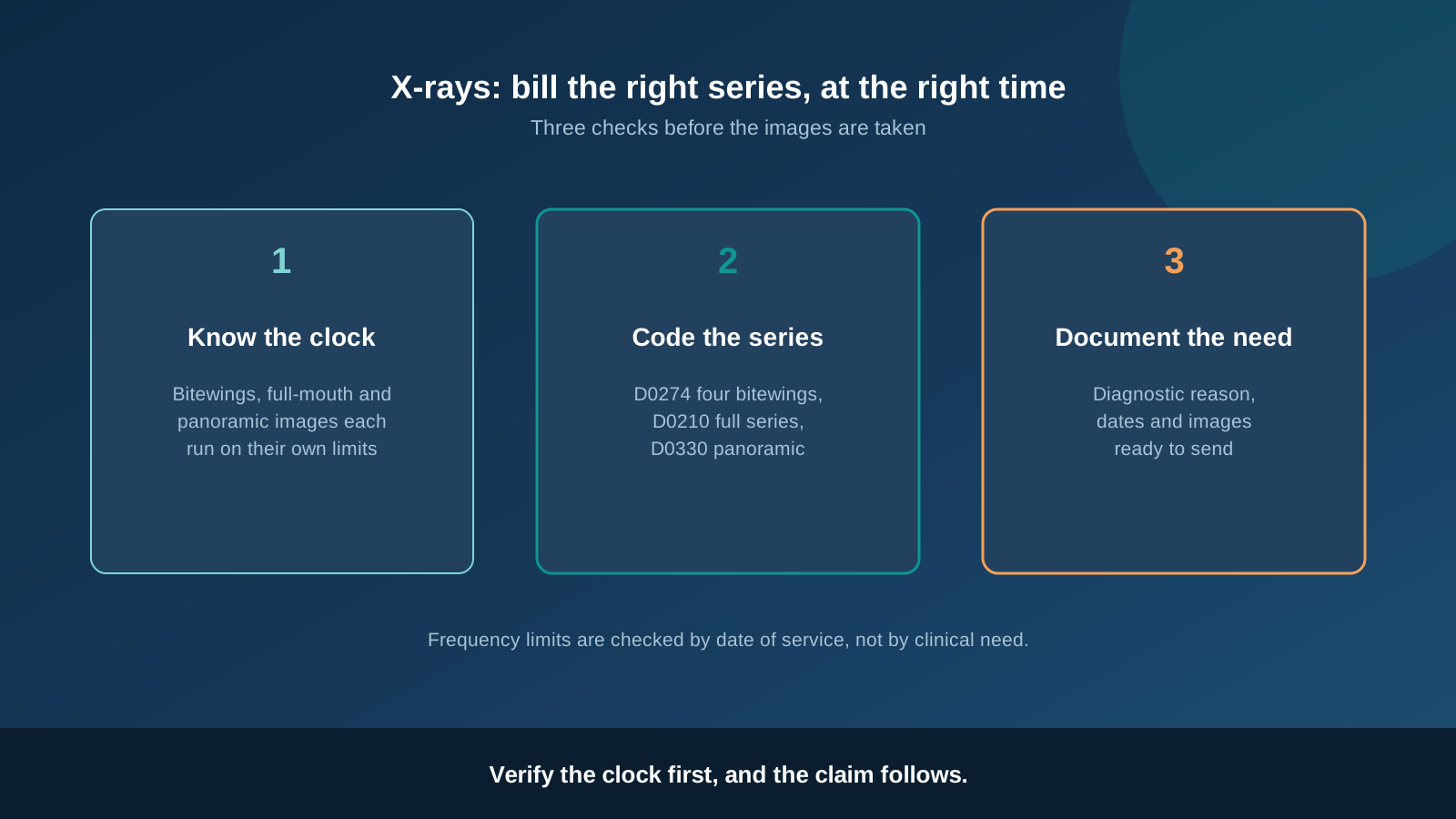
Match the code to the images taken
CDT codes radiographs by type and number of images. Report what was actually captured and diagnosed.
- D0270, D0272, D0274 and D0277: bitewings. One, two, four and seven to eight images. Pick the code that matches the number of films or sensors captured.
- D0210: intraoral complete series. At least 14 images including bitewings. Most plans treat the bitewings as part of the series.
- D0220 and D0230: periapicals. First image and each additional image, for diagnosing a specific tooth or area.
- D0330: panoramic image. A single extraoral image, often used for third molar, orthodontic or implant evaluation.
Do not report a full-mouth series when fewer than 14 images were taken. A set of periapicals plus bitewings should be billed as exactly that, not as a series.
Check the frequency clock first
Frequency is where radiograph claims fail. A common pattern is bitewings once every 12 months, and a full-mouth series or panoramic image once every three to five years. Plans differ on whether the limit runs from the last date of service or resets each calendar year, and on whether a panoramic and a full series share one limit. Our overview of frequency limitations explains how to read these rules, and eligibility verification is the step where they should be confirmed.
Two interactions catch offices out. First, a D0210 taken within the bitewing window often makes a separate D0274 deny. Second, a new patient may have images from a previous office that count toward the limit even though your chart shows none. Ask the plan for history by date, and consider whether the patient can afford to wait. If images are denied for frequency, the denial is usually a contractual write-off, not a patient balance. See write-offs and fee schedules before billing the patient.
Document the need and send what is required
Routine imaging rarely needs attachments, but diagnostic need matters when a plan questions frequency or a pre-authorization depends on the images. Record the clinical reason, such as pain, a caries risk assessment or a pre-surgical evaluation, along with the date and the tooth or area. For procedures that need proof, like crowns, extractions or scaling and root planing, send clear, dated images, as described in our claim attachments and narratives guide.
Finally, remember that many plans pay radiographs at 100 percent with no deductible, but others apply a deductible or coinsurance. Set an accurate patient estimate before the images are taken, and keep an eye on the annual maximum for patients close to their limit.
Bottom line
Radiograph billing is mostly a timing problem. Verify the last date for each image type, code the series that matches what was taken, and document why it was needed. If your team is tired of absorbing avoidable frequency denials, our insurance billing services handle verification, coding review and follow-up.
Frequently asked questions
How often will insurance pay for bitewings?
Most plans pay for bitewings once every 12 months for adults, and some allow one set every 6 to 12 months for children or high-risk patients. Check the plan's frequency by date of service, since some count 12 months from the last set and others count by calendar year.
Is a full-mouth series the same as a panoramic image?
No. D0210 is a complete intraoral series of 14 or more images, including bitewings, and D0330 is a single panoramic image. Many plans cover one or the other, but not both, once every 3 to 5 years, so confirm whether they share a limit.
Why did my bitewings deny after a full-mouth series?
Many plans treat the bitewings inside a D0210 as satisfying the bitewing benefit, so a separate D0274 within the same period denies on frequency. Check the history and time bitewings accordingly.
Can I bill periapicals with bitewings?
Yes, when periapicals are diagnostically necessary, such as for a toothache or an endodontic evaluation. Bill D0220 for the first image and D0230 for each additional image, and document the reason. Some plans cap the number of periapicals or bundle them into a full series.
Do I need to send radiographs with claims?
Not for routine imaging. Radiographs are usually required for crowns, build-ups, scaling and root planing, implants and extractions, and for any appeal or pre-authorization. Send clear digital images with the correct date.
Stop losing revenue to frequency denials
Dental Claim Professionals verifies imaging history before treatment and follows up on every denied claim.
Book a Free Consultation