
Every hygienist has seen the patient who does not fit either box. The gums are red, swollen and bleeding everywhere, there is heavy plaque and calculus, but the probe readings come from swelling rather than lost attachment and the x-rays show no bone loss. A regular cleaning undersells the work, and scaling and root planing is not supported by the diagnosis. That gap is what CDT code D4346 was created for. Many practices still avoid the code because they are unsure when it applies or how plans will pay it, and they end up either giving away chair time under D1110 or billing SRP that will not survive review.
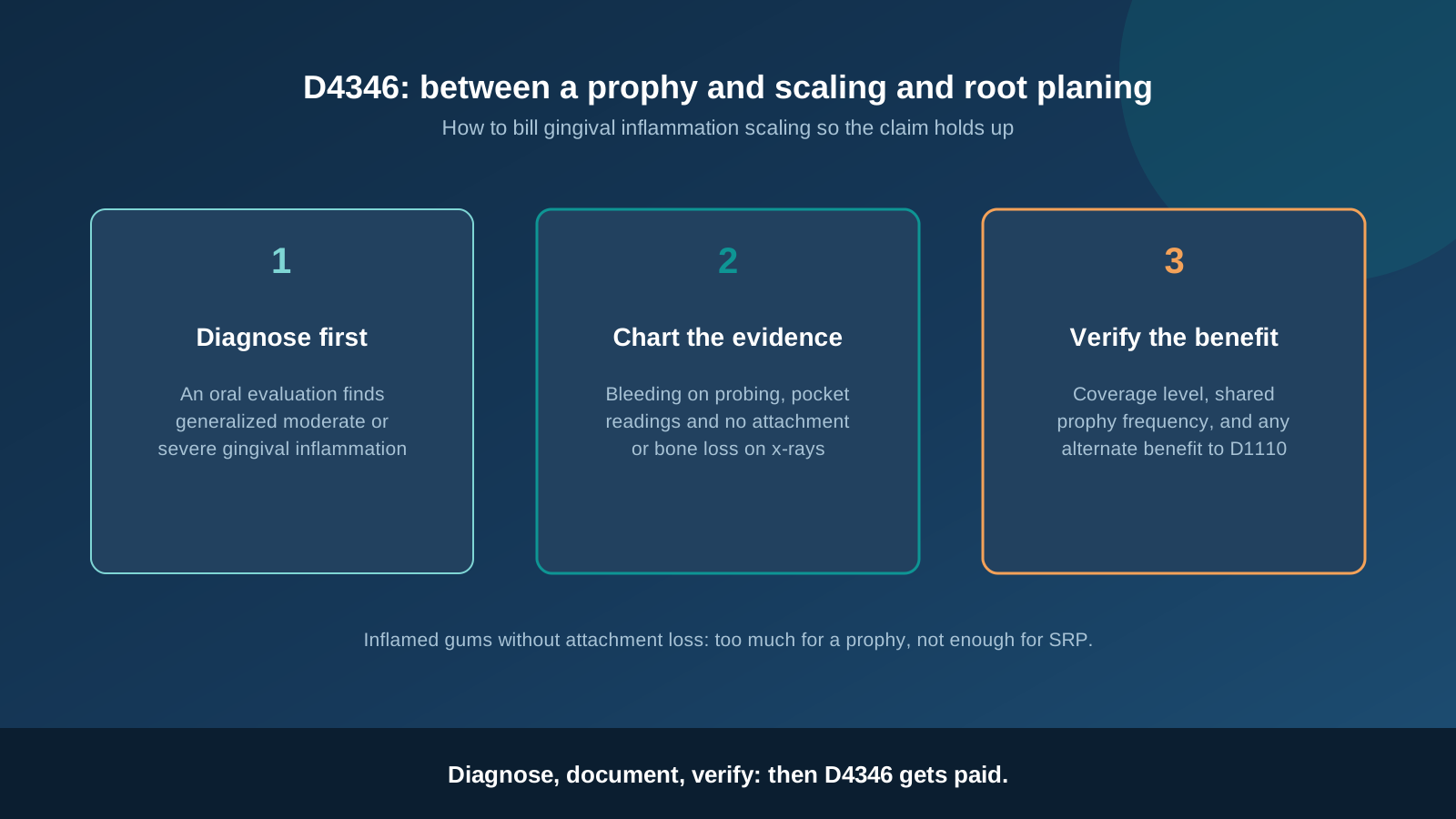
When D4346 is the right code
D4346 is defined as scaling in the presence of generalized moderate or severe gingival inflammation, full mouth, after oral evaluation. Each part of that descriptor matters on a claim:
- Generalized. The inflammation should be present throughout the mouth, not limited to a few sites. Localized gingivitis is still a prophylaxis.
- Moderate or severe. Think edema, redness, bleeding on probing and pseudopockets from swollen tissue, usually with heavy deposits. Mild inflammation does not qualify.
- No attachment loss. If there is clinical attachment loss or radiographic bone loss, the patient has periodontitis and the work belongs under D4341 or D4342.
- After oral evaluation. The dentist has to examine the patient and make the diagnosis first. D4346 is commonly billed the same day as a periodic or comprehensive exam.
It is also not the same as D4355, full-mouth debridement. D4355 is a preliminary procedure that removes deposits so an evaluation can happen at a later visit. D4346 is a definitive treatment after the evaluation has already been done. The two should not be billed together, and D4346 should never be billed on the same date as D1110.
What to document
D4346 claims are reviewed against the chart, so the record needs to show why this patient needed more than a routine cleaning. A clean note includes:
- The dentist's diagnosis of generalized moderate or severe gingivitis.
- A full-mouth periodontal charting with probe depths and bleeding points, so it is clear the readings reflect swelling rather than lost attachment.
- Current radiographs showing no bone loss.
- A short description of the tissue and deposits, and the plan to re-evaluate at the next visit.
Some payers ask for the charting with the claim. Sending it up front with a one-line narrative avoids a request for information and the delay that comes with it.
How plans cover D4346
Payer handling of D4346 is less consistent than for most preventive codes, which makes verification worth the extra minute. Ask four things:
- Is it covered, and at what level? Some plans pay it as preventive, some as basic, and some exclude it.
- Does it share a frequency limit? Many plans count D4346 against the same twice-a-year limit as D1110 and D4910, so it can use one of the patient's covered cleanings. See frequency limitations for how these shared limits work.
- Is there an alternate benefit? Some plans pay D4346 at the D1110 allowance. In network, check your contract before billing the patient the difference.
- Are there age or history limits? A few plans limit the code by age or will not pay it within a set period after SRP.
Use the answers to give the patient an estimate before treatment. Patients who think of every visit as a "free cleaning" are more receptive when they hear in the chair why today is different and what their portion is likely to be.
Bottom line
D4346 fills a real clinical gap, and billed correctly it pays the practice for work that otherwise gets written off as a routine cleaning. Diagnose generalized gingivitis at an exam, chart the evidence that rules out attachment loss, and verify how each plan treats the code. If your team wants help getting perio and hygiene codes paid the first time, our insurance billing services cover verification, coding review and claim follow-up.
Frequently asked questions
What is CDT code D4346?
D4346 is scaling in the presence of generalized moderate or severe gingival inflammation, full mouth, after oral evaluation. It is for patients with swollen, bleeding gums and heavy deposits but no periodontal attachment loss or bone loss.
What is the difference between D4346, D1110 and D4341?
D1110 is a routine prophylaxis for a healthy or mildly inflamed mouth. D4346 is for generalized moderate or severe gingivitis without attachment loss. D4341 and D4342 are scaling and root planing for periodontitis, where there is attachment loss and bone loss.
Can D4346 be billed on the same day as an exam?
Yes. The code requires an oral evaluation to establish the diagnosis, so it is commonly billed the same day as D0120, D0150 or D0180. It should not be billed with D1110 or D4355 on the same date.
Does D4346 count toward the patient's two cleanings per year?
On many plans it does. Payers often group D4346 with D1110 and D4910 under a shared frequency limit, so a D4346 in March can use one of the patient's two covered cleanings. Verify this before scheduling.
Why did the plan pay D4346 as a regular cleaning?
Some plans apply an alternate benefit and pay D4346 at the D1110 allowance. In network, the patient's portion is usually limited to the D4346 fee schedule amount minus the plan payment, so check your contract before billing the difference.
Get paid for the hygiene work you actually do
Dental Claim Professionals verifies hygiene benefits and reviews perio coding before claims go out.
Book a Free Consultation