
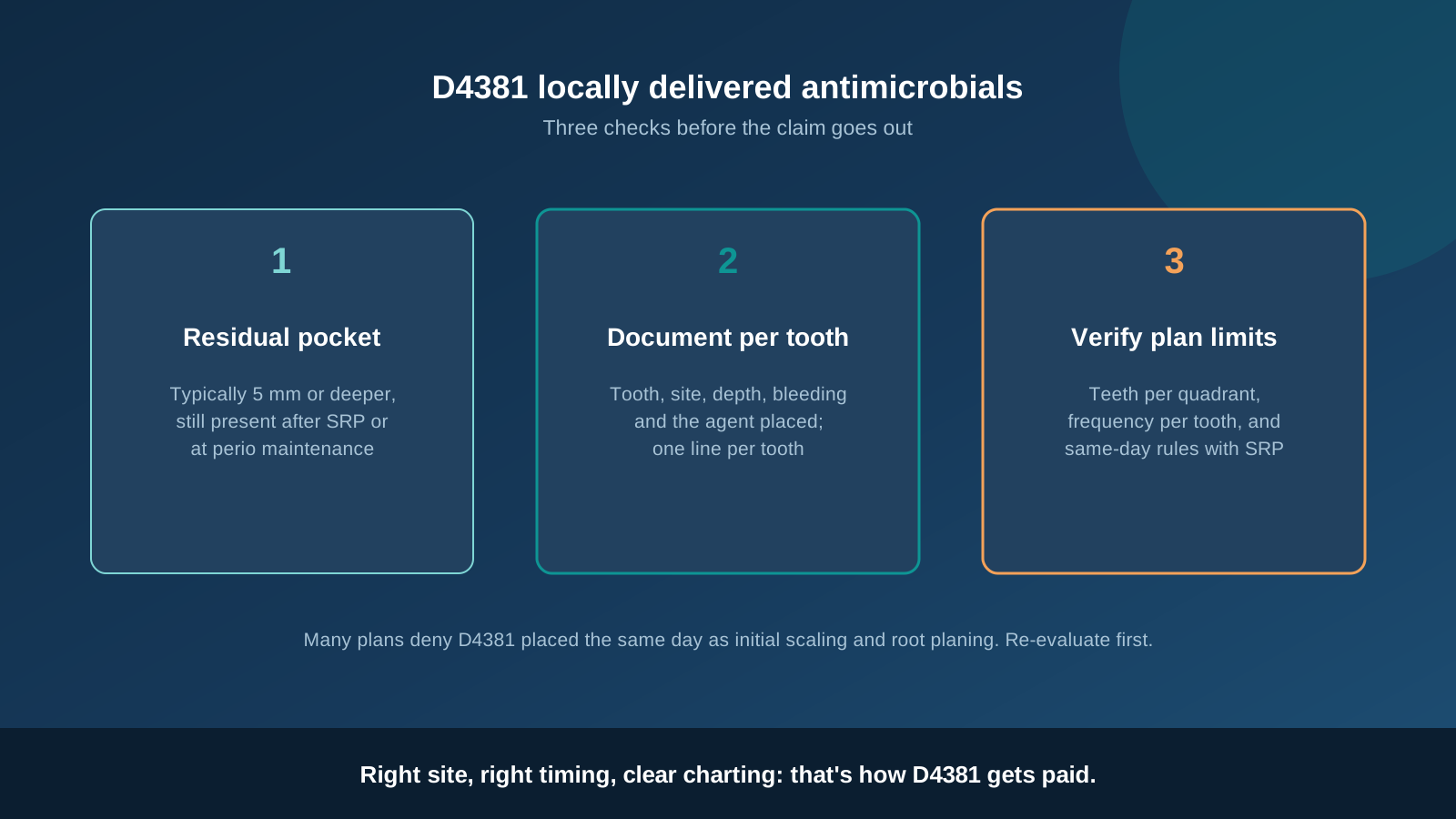
A periodontal maintenance patient still has a 6 mm pocket with bleeding on the distal of #30, months after scaling and root planing. The hygienist places a sustained-release antibiotic in that pocket. That is D4381, locally delivered antimicrobials. The product is expensive, the procedure takes a few minutes, and the claim is denied more often than almost any other perio code. Most denials come back to three things: timing, pocket depth and plan limits.
What D4381 covers, and what it doesn't
D4381 is localized delivery of antimicrobial agents via a controlled release vehicle into diseased crevicular tissue, per tooth. The agent stays in the pocket and releases over days or weeks. Minocycline microspheres and doxycycline gel are common examples.
- One line per tooth, not per site. If #30 has deep pockets on the mesial and distal, that is still one D4381. Billing per site is a common reason for partial denials and recoupments.
- Not irrigation. Rinsing a medicament through the pocket is D4921, gingival irrigation, reported per quadrant. Many plans don't cover it, and it should never be billed as D4381.
- Not a prescription. Medication sent home with the patient is a different code and usually not a dental benefit.
Timing: why same-day claims get denied
Most payers treat D4381 as an adjunct for pockets that don't respond to mechanical therapy. If it shows up on the same date as initial scaling and root planing, many plans deny it because there was no chance to see whether SRP alone worked. Some plans pay it with SRP, so check, but the safer pattern is:
- Re-evaluate after SRP, commonly four to six weeks later, and place the antimicrobial only where a pocket of 5 mm or more persists.
- Use it at periodontal maintenance for isolated sites that stay deep or bleed. D4910 and D4381 on the same date is a normal, payable combination with many plans.
- Know the frequency limit. Many plans pay D4381 on the same tooth once every 12 to 24 months, and some cap the number of teeth per quadrant or per visit. A frequency limit missed at verification turns into a patient balance nobody planned for.
During verification, ask three questions: is D4381 a covered benefit, what pocket depth does the plan require, and is it payable on the same date as SRP? If it isn't covered, collect a signed financial agreement before placement, as with any non-covered service.
What to document
D4381 claims are often reviewed, so send the records up front:
- Current periodontal charting showing the depth and bleeding at the treated site, ideally next to the earlier charting from before SRP.
- The date of prior SRP, or the patient's maintenance history, so the reviewer can see the pocket persisted after therapy.
- Tooth number, site and product for each line.
A short narrative ties it together: "#30 DL 6 mm with BOP at perio maintenance; SRP completed 03/2026; site persists after mechanical therapy. Minocycline microspheres placed."
Bottom line
D4381 gets paid when it is billed per tooth, placed in a pocket that persisted after therapy, and backed by charting that shows it. Verify coverage, pocket depth requirements and same-day rules before the product goes in, and set patient expectations when the plan won't pay. If your team wants help keeping perio claims clean, our insurance billing services cover verification, coding review and appeals.
Frequently asked questions
What is CDT code D4381?
D4381 is localized delivery of antimicrobial agents via a controlled release vehicle into diseased crevicular tissue, per tooth. It covers placing a sustained-release antibiotic or antiseptic, such as minocycline microspheres or a doxycycline gel, into a periodontal pocket.
Can D4381 be billed the same day as scaling and root planing?
It can be reported, but many plans deny D4381 when it is placed on the same date as initial scaling and root planing. Most payers expect the pocket to be re-evaluated after SRP and the antimicrobial used only where a deep pocket persists, often four to six weeks later or at a periodontal maintenance visit.
How many teeth can be billed for D4381?
D4381 is reported per tooth, not per site, so a tooth with several deep sites is still one line. Many plans also cap the number of teeth per quadrant or per visit and limit how often the same tooth can be treated, commonly once every 12 to 24 months.
Does dental insurance cover locally delivered antimicrobials?
Coverage varies widely. Some plans pay D4381 as a periodontal service when pocket depth criteria are met, usually 5 mm or more after prior therapy. Others exclude it or treat it as an optional add-on, so verify the benefit and any pocket depth requirement before treatment.
What is the difference between D4381 and D4921?
D4381 is a controlled-release agent left in the pocket and is reported per tooth. D4921 is gingival irrigation with a medicinal agent, reported per quadrant, where the solution is rinsed through and not left in place. Many plans do not cover D4921 at all.
Stop writing off D4381 claims
Dental Claim Professionals verifies perio benefits and reviews coding before claims go out.
Book a Free Consultation