
Sedation and anesthesia are among the most inconsistently paid services in a dental office. Codes are tied to the depth of sedation and the minutes delivered, many dental plans exclude them, and medical plans have their own rules. Practices that treat anxious adults, children and complex oral surgery cases see the most denials. A consistent process of coding, timing and verifying keeps these claims paid.
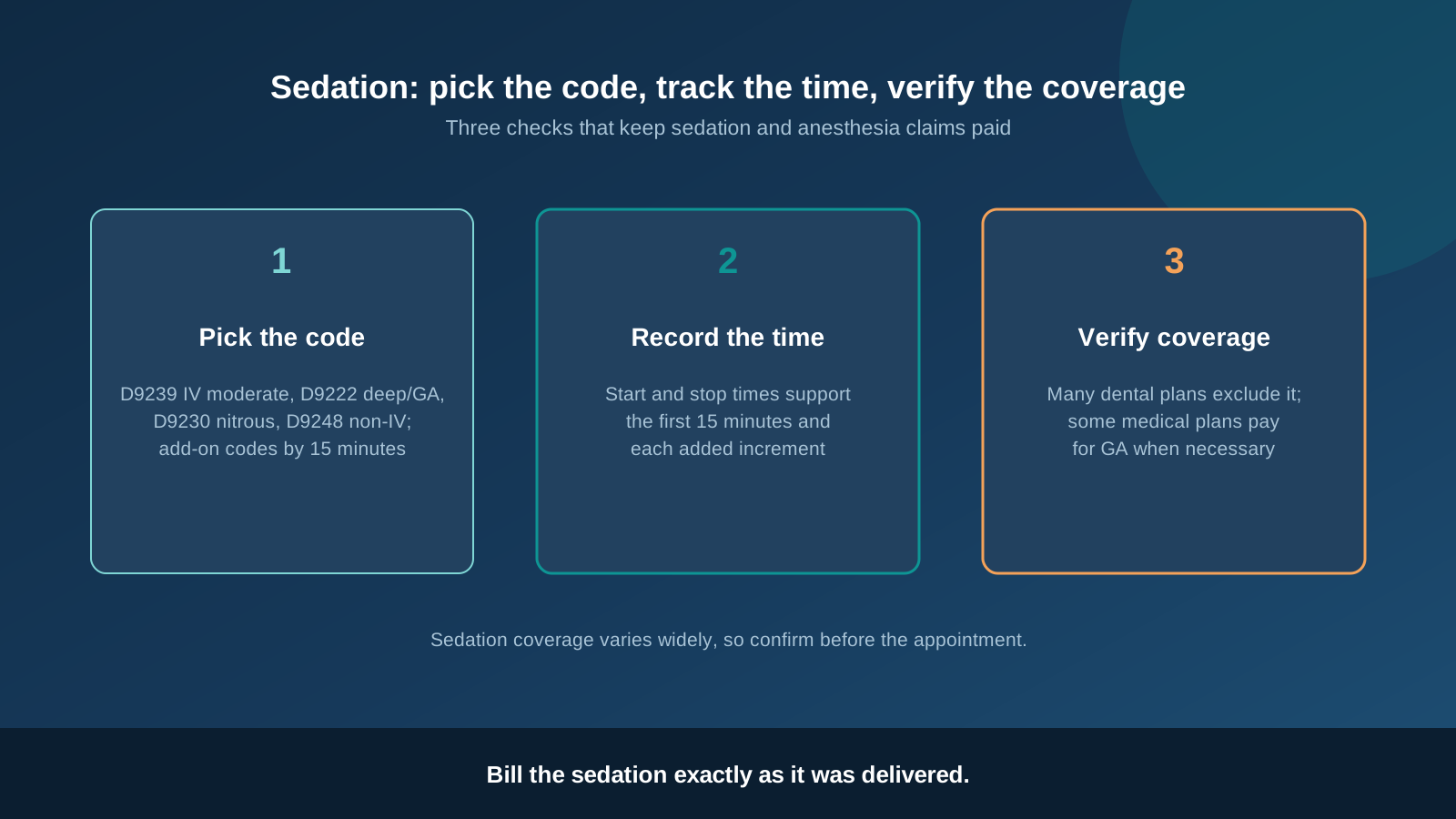
Match the code to the level of sedation
CDT separates sedation by depth and route, so the code must reflect what was actually delivered.
- D9230: nitrous oxide. Inhalation of nitrous oxide or analgesia, anxiolysis, reported once per visit.
- D9239 and D9243: IV moderate (conscious) sedation. D9239 covers the first 15 minutes and D9243 each additional 15 minutes.
- D9222 and D9223: deep sedation or general anesthesia. D9222 covers the first 15 minutes and D9223 each additional 15 minutes.
- D9248: non-intravenous conscious sedation. This includes oral and other non-IV routes of moderate sedation.
Sedation does not replace the clinical service. The procedure, such as an extraction, is billed with its own code on the same claim. Some payers also require a separate evaluation code, such as D9219, before deep sedation or general anesthesia.
Record time and medical necessity
D9222 and D9239 are time-based, and payers audit the minutes. Chart the start time, the stop time and the monitoring record, then report additional units only for completed 15-minute increments. Add the diagnosis and the reason sedation was needed, such as extreme anxiety, a young age, a special health care need or an extensive surgical plan. When a claim is denied, this record is what makes an appeal succeed, and a narrative can state the necessity up front when the plan requires it.
Verify dental versus medical coverage
Many dental plans exclude sedation or pay it only with specific procedures, ages or diagnoses. Include it in your eligibility verification, and ask about limits, waiting periods and prior authorization. When general anesthesia is medically necessary, the medical plan may pay, which can involve medical cross-coding, and the anesthesia provider may bill separately. Give the patient a written estimate before the appointment, since sedation fees are often a patient responsibility.
Bottom line
Sedation billing comes down to three steps: report the depth of sedation with the right code, document the minutes and necessity, and confirm who will pay before the patient is in the chair. If you would rather hand off the verification and follow-up, our insurance billing services can handle it.
Frequently asked questions
What is the difference between D9239 and D9222?
D9239 reports intravenous moderate (conscious) sedation or analgesia, and D9222 reports deep sedation or general anesthesia. Each covers the first 15 minutes, with D9243 and D9223 reporting each additional 15 minutes.
How do I bill nitrous oxide?
Report D9230, inhalation of nitrous oxide or analgesia or anxiolysis, once per visit. Many plans do not cover it, so verify benefits and give the patient an estimate.
Why was my sedation claim denied?
The most common reasons are a plan exclusion for sedation, a missing medical necessity statement, or no recorded start and stop times. Check the plan's rules, then appeal with the chart documentation.
Can sedation be billed to medical insurance?
Sometimes. Medical plans may pay for general anesthesia when it is medically necessary, such as for a young child or a patient with special needs. Policies vary, so verify with the medical payer and obtain any prior authorization.
Can I bill the patient if the plan denies sedation?
Only if your network contract allows it. In-network offices are often barred from charging for non-covered services unless the patient agreed in advance, so check the contract and give a written estimate first.
Get paid for sedation services
Dental Claim Professionals verifies benefits up front and follows up on every denied claim.
Book a Free Consultation