
Extractions look straightforward on the schedule, but the claim is where they get complicated. The difference between a simple and a surgical extraction can be hundreds of dollars, and payers know it. Surgical codes draw more scrutiny, more downcoding and more requests for records. The good news is that most problems come down to documentation and a few pre-treatment checks.
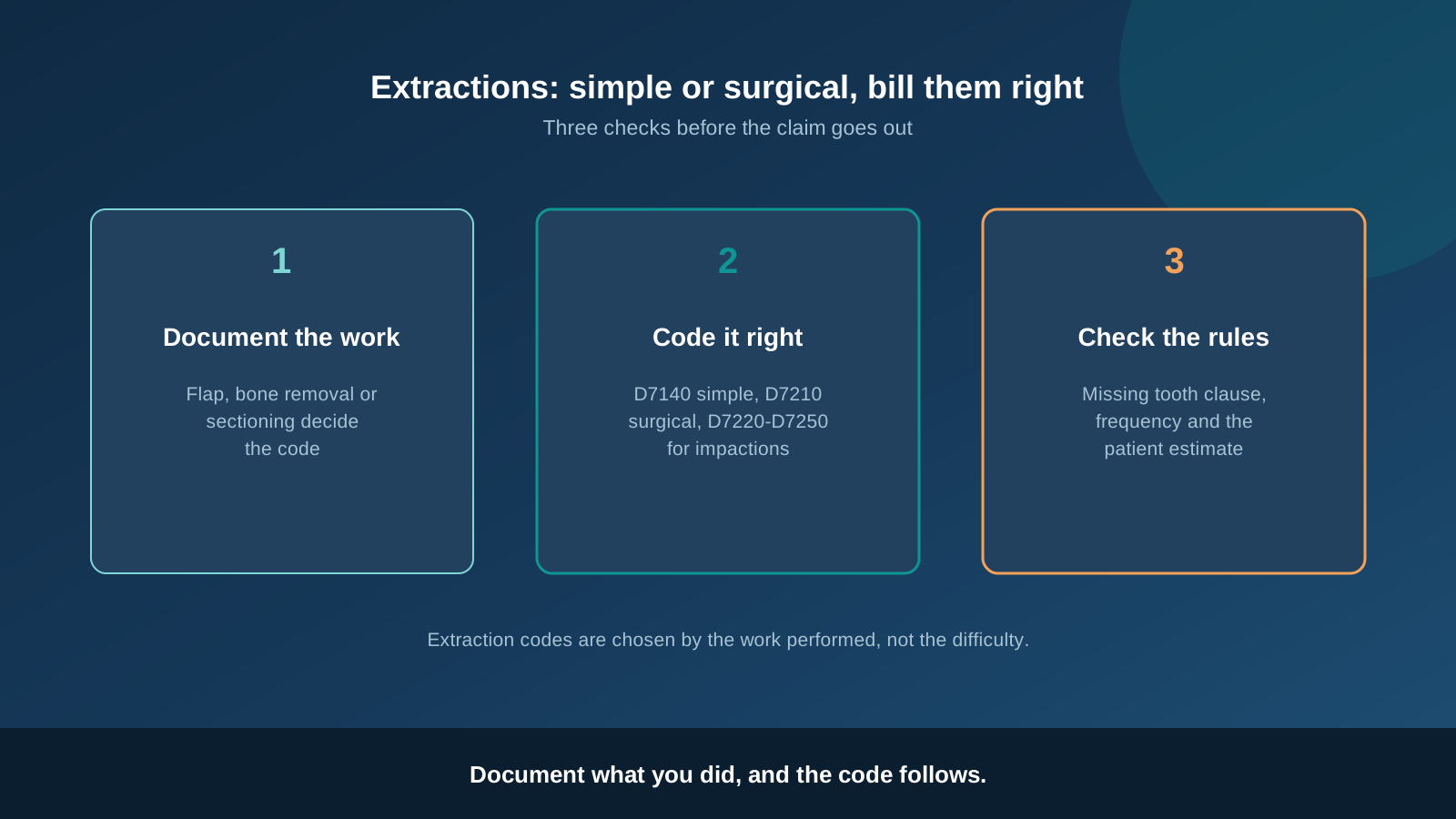
Choose simple or surgical by the work performed
CDT defines the two categories by technique, not by how hard the case felt. Use the code that matches what happened in the chair.
- D7140, extraction of erupted tooth or exposed root. Elevation and forceps removal. Routine closure, if any, is included.
- D7210, surgical removal of an erupted tooth. Requires elevation of a mucoperiosteal flap and removal of bone or sectioning of the tooth, with closure when needed.
- D7220 to D7250, impactions and residual roots. Soft tissue, partial bony and complete bony impactions are coded by how the tooth is covered, and D7250 covers surgical removal of residual roots.
One extraction code per tooth. If a case starts simple and turns surgical, bill the surgical code and explain the change in the notes.
Document so the code survives review
When a payer downcodes D7210 to D7140, the cause is almost always a thin chart. Your clinical note should record the flap, any bone removal, any sectioning and the reason it was needed, such as ankylosis, root curvature or a fractured crown. Attach a pre-operative radiograph that shows the problem, and add a short narrative when the case is complex. Our guide to claim attachments and narratives covers what to send, and downcoding explains how to respond when a line is reduced anyway. If the payer still will not budge, follow the steps in our appeals guide.
Be careful with bundling as well. Closure, routine local anesthesia and post-operative care are normally included in the extraction fee, so do not report them separately. See bundling and unbundling for the usual traps.
Check coverage before you extract
Extractions are usually a basic or major service, which brings in the deductible, a coinsurance percentage and the annual maximum. Two rules deserve a closer look during eligibility verification:
- Missing tooth clauses. If the tooth is extracted before the effective date, replacing it later may be excluded. Review the missing tooth clause before treatment, particularly for new patients.
- Medical coverage. Extractions linked to trauma, infection or a planned medical procedure may belong on a medical claim. See medical cross-coding.
Then give the patient a realistic number up front using a time-of-service estimate, and consider a predetermination for complex surgical cases, as described in our predetermination guide.
Bottom line
Accurate extraction billing comes down to three habits: code by the technique used, record the flap, bone and sectioning details, and verify coverage rules before the appointment. If your team would rather not chase these claims, our insurance billing services handle verification, coding review and follow-up.
Frequently asked questions
What is the difference between D7140 and D7210?
D7140 is a simple extraction of an erupted tooth or exposed root using elevation and forceps. D7210 is a surgical extraction that requires a mucoperiosteal flap, and may include bone removal or sectioning of the tooth. The code must match what was actually done and documented.
Can I bill D7140 and D7210 for the same tooth?
No. Report one extraction code per tooth. If a simple extraction becomes surgical mid-procedure, bill only the surgical code and document why the approach changed.
Why was my extraction downgraded to a simple extraction?
Payers often downcode D7210 to D7140 when the chart lacks a flap, bone removal or sectioning note, or when no radiograph supports the difficulty. Send a narrative and the periapical or panoramic image with the claim.
Is an extraction covered by medical or dental insurance?
Routine extractions are normally dental, but extractions tied to trauma, infection, radiation therapy or a medical condition may be payable by medical insurance. Check both before treatment and see our guide to medical cross-coding.
Do missing tooth clauses affect extractions?
They affect what happens afterward. If a tooth is extracted before the patient's coverage begins, the plan may deny the later implant, bridge or partial denture replacing it, so verify before you extract.
Get surgical claims paid at the right code
Dental Claim Professionals reviews coding, attaches the right records and follows up on every extraction denial.
Book a Free Consultation