
A crown that pops off over a holiday meal is one of the most common emergency calls a practice gets, and one of the most commonly miscoded. The fix might take fifteen minutes, but the claim has to answer questions the chair time doesn't: did the restoration come off intact or break, who placed it and when, and was anything added to the tooth? Get those answers wrong and the visit is denied as part of the original crown fee, or flagged as an unbundled buildup. Here is how to code re-cementations and repairs, the rules payers apply, and what to document.
Choosing the code
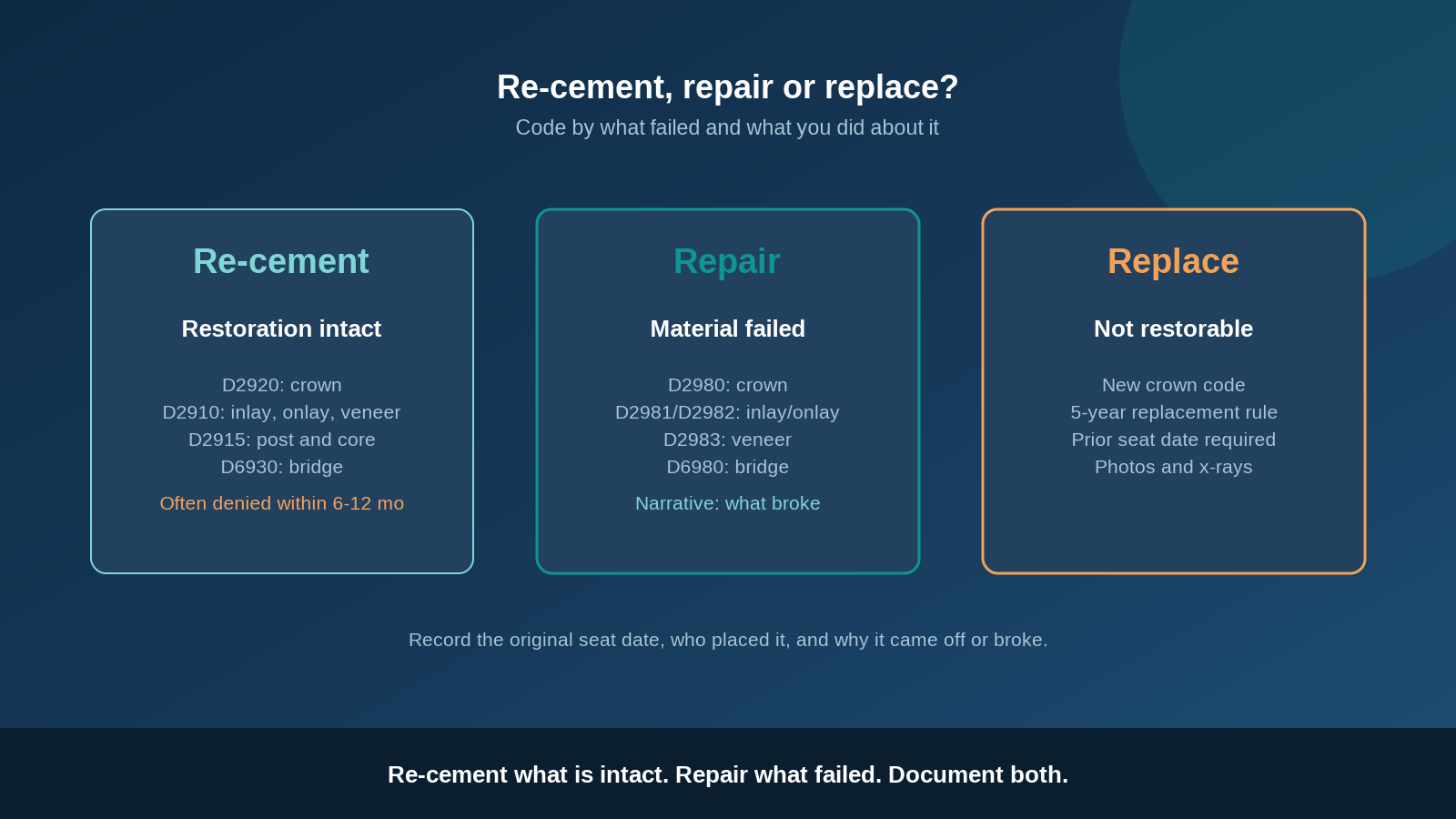
Start with what came out of the patient's mouth. If the restoration is intact and goes back on, it's a re-cementation. If the material itself failed and you fixed it, it's a repair.
- D2920, re-cement or re-bond crown. The crown came off whole and was cleaned and re-seated. Report it with the tooth number.
- D2910 and D2915. D2910 re-cements or re-bonds an inlay, onlay, veneer or partial coverage restoration. D2915 re-cements an indirectly fabricated or prefabricated post and core.
- D6930 for bridges. A fixed partial denture that comes off is one D6930 for the whole bridge, not a D2920 per abutment.
- D2980 to D2983 for repairs. D2980 repairs a crown, D2981 an inlay, D2982 an onlay and D2983 a veneer, when the restorative material failed. D6980 covers bridge repairs. These are "by report" codes, so a narrative is expected.
- Replacement is a new crown. If the crown is cracked through or the margin is open with decay, bill the crown code again and expect the plan's replacement rule to apply.
The rules payers apply
- The six-to-twelve-month window. Most plans consider re-cementation by the placing office within six months, and some within twelve, to be included in the original crown fee. As a PPO provider you usually can't bill the patient for it either, so check your contract before collecting.
- Different office, different rules. When another dentist placed the crown, the window usually doesn't apply, but the payer may still ask for the seat date.
- Buildups draw scrutiny. Billing a new core buildup (D2950) with D2920 needs proof the original core was lost and the tooth needed it for retention. Routine pairing is treated as unbundling.
- Replacement limits. A new crown within five years (seven on some plans) of the last one is usually denied unless the narrative shows the old crown is unserviceable through no fault of the patient. Check frequency history first.
- Cosmetic exclusions. Veneer re-bonding and repair are often excluded with the veneer itself. Verify before you quote the patient.
What to document
- The original seat date and whether your office placed it.
- How it failed: came off intact, porcelain fracture, open margin, recurrent decay or lost core.
- What you did: cement used, any repair material, and whether new tooth structure was replaced.
- A periapical or intraoral photo when billing a repair, a buildup or a replacement.
A one-line narrative prevents most denials: "#30 PFM crown seated 3/2/24 by another office. Crown dislodged intact, no decay, core intact. Cleaned and re-cemented with resin-modified glass ionomer, D2920, 11/27/26."
Bottom line
Re-cementation and repair claims are small dollars, but they add up and they are easy to get right. Re-cement what came off intact, repair what failed, and replace only what can't be saved, and always record the original seat date and who placed it. If the visit was an after-hours emergency, consider whether a limited exam and palliative code applies too. If your office wants help catching these before they deny, our insurance billing services cover verification, coding review and appeals.
Frequently asked questions
What is the difference between D2920 and D2980?
D2920 is re-cementing or re-bonding a crown that came off intact, with no change to the crown itself. D2980 is repairing a crown whose material failed, such as chipped porcelain repaired in the mouth. If the crown is not restorable and has to be remade, bill a new crown code instead.
Why was crown re-cementation denied?
Most plans will not pay D2920 within six to twelve months of the original seat date when the same office placed the crown, because re-cementation in that window is treated as part of the crown fee. Missing tooth numbers, no seat date and a patient-paid frequency limit are the other common causes.
Can I bill a new core buildup when re-cementing a crown?
Only if a new buildup was actually placed because the original core was lost or fractured and the tooth needed it for retention. Document the missing tooth structure with a radiograph or photo. Billing D2950 routinely with D2920 is a common audit flag.
How do I bill a re-cemented bridge?
Use D6930 once for the whole fixed partial denture, not D2920 per abutment. If a pontic or retainer was repaired, report D6980 with a narrative that names the unit and what failed.
Does insurance pay to repair a veneer?
D2983 is a valid repair code, but many plans exclude veneers as cosmetic and deny the repair along with them. Verify coverage first, and if the veneer restores a fractured tooth rather than aesthetics, say so in the narrative.
Get restorative claims paid the first time
Dental Claim Professionals verifies benefits and reviews coding before claims go out.
Book a Free Consultation