
A dental bridge is one procedure to the patient but several line items to the payer. Each missing tooth and each supporting crown is reported separately, the benefit is often capped by a replacement limit, and plans routinely question whether the tooth was lost before coverage began. Offices that treat a bridge like a single crown tend to see denials, short payments and angry patient balances. A clear process fixes most of it.
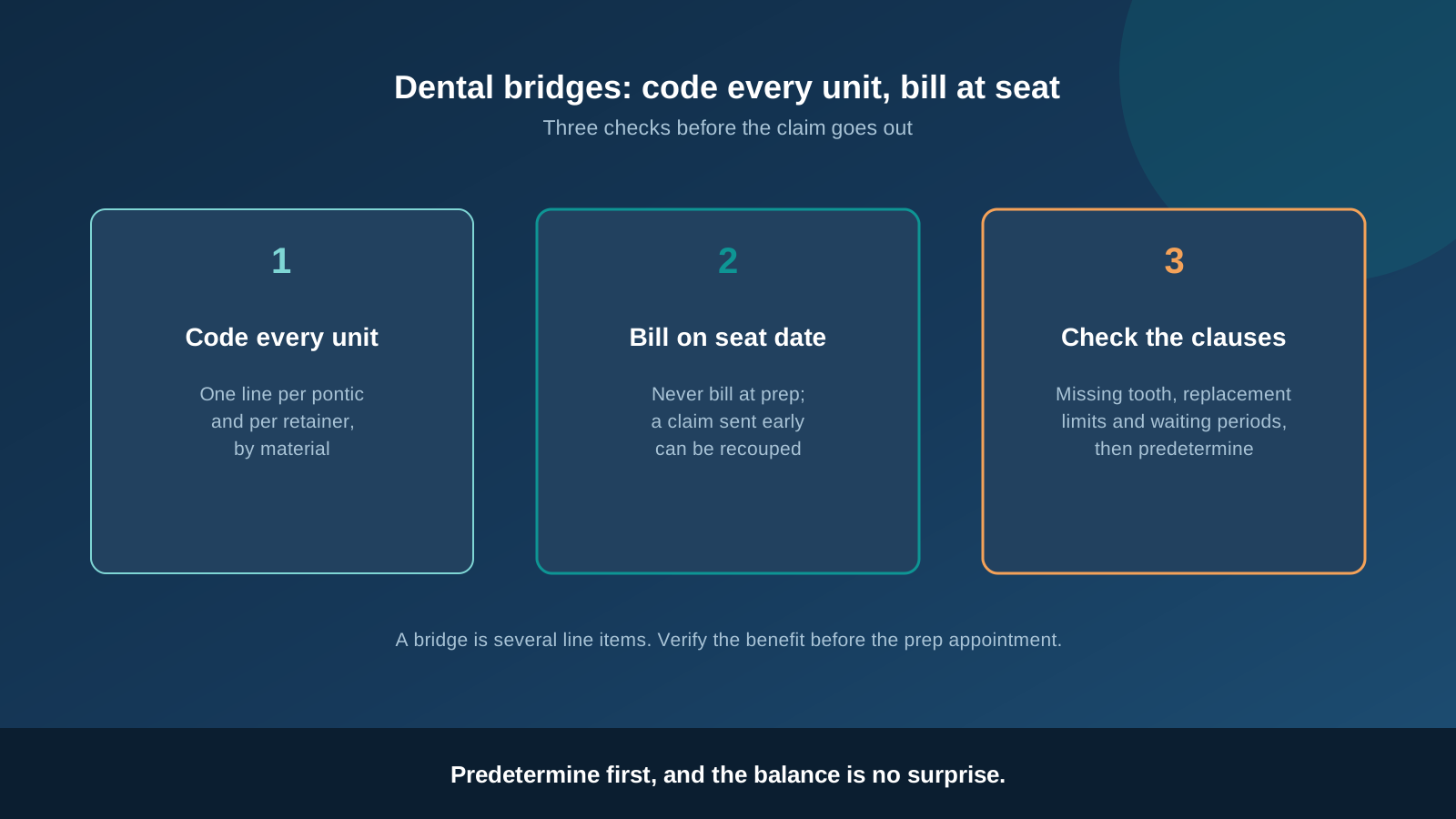
Code every pontic and retainer
CDT reports a fixed partial denture as individual units. Each replaced tooth is a pontic (for example D6240 for porcelain fused to high noble metal, or D6245 for porcelain/ceramic), and each supporting tooth is a retainer (such as D6740 for a porcelain/ceramic retainer crown or D6750 for porcelain fused to high noble metal). Retainer inlays and onlays have their own codes. The pontic and retainer codes should match the material actually used, and every unit should carry its own tooth number.
A three-unit bridge therefore produces three lines: two retainers and one pontic. Add a build-up only when it is clinically justified, as covered in our crown and build-up billing guide, since unsupported build-ups are a common source of downcoding. Many plans also pay the bridge at a major-services percentage and may apply a alternate benefit clause to a more costly material.
Bill on the seat date and verify the clauses
Submit on the cementation date, never on the preparation date. A claim sent at prep can be paid and later recouped if the patient does not return, and recoupments are painful to unwind (see dental insurance recoupments).
Two benefit rules decide most bridge outcomes. First, the missing tooth clause can exclude replacing a tooth that was extracted before the patient's effective date. Second, frequency limitations typically allow a replacement prosthesis only once every five to ten years, counted from a prior bridge, even one placed elsewhere. Also confirm any waiting period for major services and the remaining annual maximum, because a bridge can consume most of a typical benefit in one visit.
Predetermine, document and estimate
Because bridges are high-dollar, a predetermination is well worth the wait. It confirms the missing tooth clause, the percentage and the replacement history in writing. Keep a pre-operative radiograph, the extraction date when known, and clinical notes explaining why a bridge was chosen. Attach them when the plan asks, following our claim attachments and narratives guidance.
Then build the patient estimate from the predetermination allowance, including the annual maximum remaining, and collect the patient portion in stages around the prep and seat visits. Patients who see the number early rarely dispute it later.
Bottom line
Bridge billing is a matter of discipline: code each unit, bill at seat, and verify the clauses before anyone is numb. If your team would rather not chase these claims, our insurance billing services handle verification, predeterminations and follow-up.
Frequently asked questions
Do I bill a bridge as one code?
No. A fixed partial denture is reported with one code for each pontic and one code for each retainer crown or retainer inlay, all dated the seat date. The plan may total them into a single benefit.
When do I submit the claim for a bridge?
On the cementation date, not the preparation date. Billing at prep can cause denials or recoupments if the patient never returns for the seat appointment.
Why was a bridge denied under the missing tooth clause?
If the tooth was lost before the patient's coverage began, many plans exclude replacing it. Verify extraction dates and the clause before treatment, and consider a predetermination.
How often will insurance pay for a replacement bridge?
Most plans allow a replacement only every five to ten years, measured from the prior prosthesis even if it was placed by another office. Ask the patient and the payer.
Is an implant crown billed the same way as a bridge retainer?
No. Implant-supported bridges use separate abutment and retainer codes, and many plans handle them differently from conventional bridges, so verify implant coverage separately.
Get major services paid the first time
Dental Claim Professionals verifies clauses, predetermines bridges and builds accurate patient estimates.
Book a Free Consultation