
Dentures look simple on a treatment plan, but they generate some of the largest patient balances and the most confusing denials in a general practice. The code depends on the arch and type of prosthesis, the payer limits how often it will pay, and the follow-up work, from adjustments to relines, has its own rules. A few habits keep these claims clean and the patient informed.
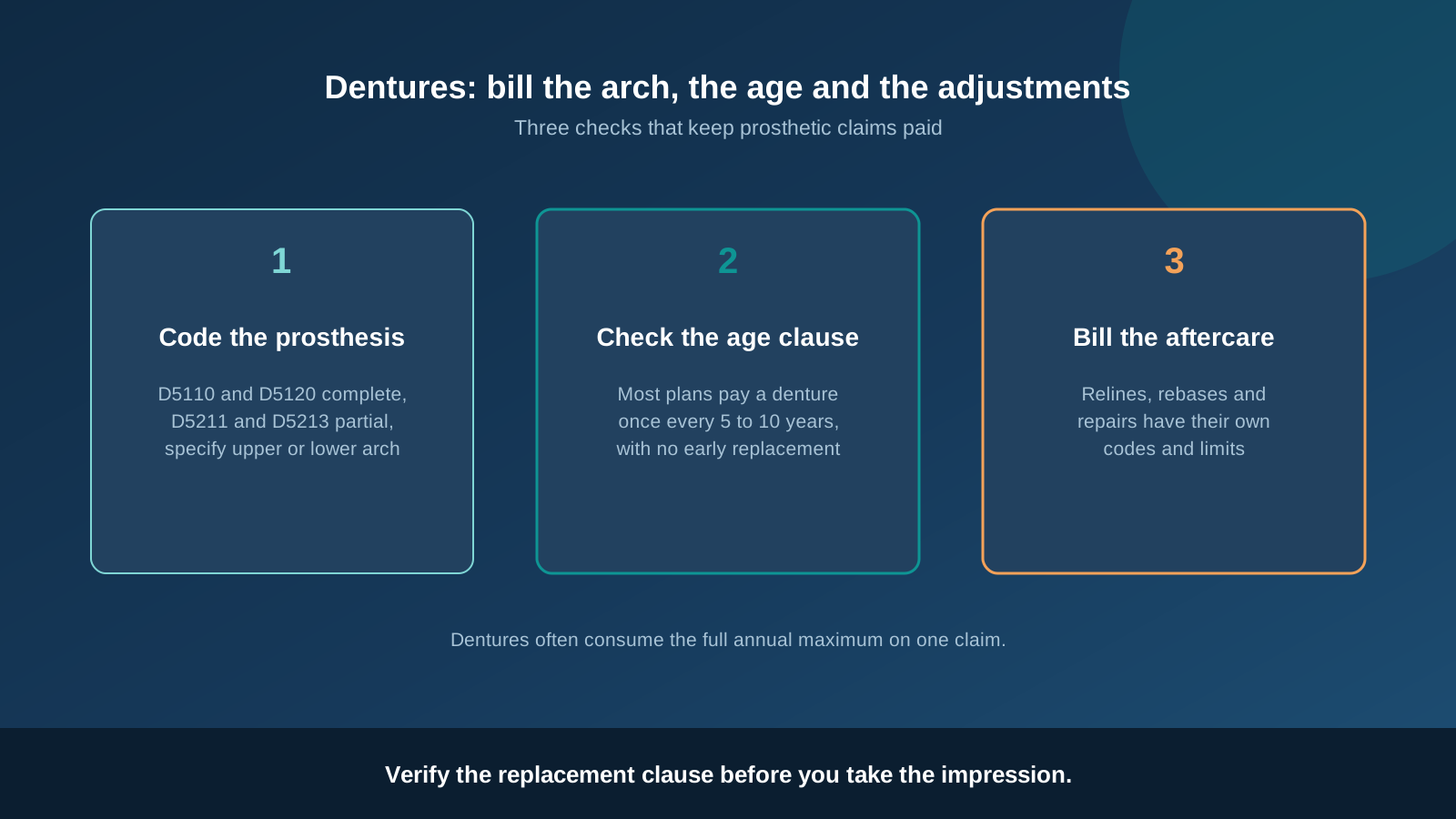
Choose the code by prosthesis and arch
Denture codes are set by the type of appliance and the arch, so every claim needs the right one.
- D5110 and D5120: complete dentures. Maxillary and mandibular. Immediate complete dentures use D5130 and D5140.
- D5211 and D5212: resin-base partials. Maxillary and mandibular. Cast-metal partials use D5213 and D5214, and flexible-base partials have their own codes that some plans treat as an alternate benefit.
- D5710 to D5721: rebases. A new base is made while the teeth are kept. D5730 to D5761: relines resurface the tissue side. Both are usually chairside or laboratory, so choose the code that matches how the work was done.
- D5410 to D5422 and D5511 to D5671: adjustments and repairs. Billed separately from the denture, often with a limit per year.
Report the arch on every line, and use a narrative when the plan is unusual, such as an overdenture or a denture opposing natural teeth. Our guide to claim attachments and narratives covers what payers expect to see.
Verify replacement limits and clauses first
The most common denture denial is a replacement limit. Most plans pay for one prosthesis per arch every five to ten years, and they count from the date of the last one, even if it was placed by a different office or an earlier plan. Ask for the prior date of service when you verify eligibility, and confirm the waiting period, since prosthetics are nearly always a major service.
Two other clauses matter. The missing tooth clause can deny a partial that replaces teeth lost before coverage began, and the alternate benefit clause may pay a partial at the rate of a complete denture or a resin partial at the cost of a cast-metal one. Knowing both before treatment lets the patient decide with accurate numbers.
Bill aftercare and estimate the patient portion
Report the delivery date as the date of service, not the impression visit, to avoid a recoupment if the patient never returns. Many plans include post-delivery adjustments in the denture fee for six months and will deny a reline in that window, so track both dates before billing aftercare.
Because a denture often exceeds the annual maximum by itself, the patient may owe half the fee or more. Give a written estimate before the impression, collect the lab-fee portion up front where your policy allows, and consider a predetermination for complex cases.
Bottom line
Denture billing comes down to three habits: code the prosthesis and arch precisely, verify replacement limits and clauses before the impression, and bill aftercare on its own timeline with a clear patient estimate. If your team would rather not chase prosthetic denials, our insurance billing services handle verification, claim submission and follow-up.
Frequently asked questions
How often does dental insurance pay for a new denture?
Most plans pay for a complete or partial denture once every five to ten years per arch, counted from the date of the last prosthesis. Ask the payer for the exact replacement period and whether it counts dentures placed under a prior plan.
Can I bill a reline and a new denture around the same time?
Plans usually deny a reline within six months of a new denture, and some bundle post-delivery adjustments into the denture fee for the first six months. Use D5730 to D5761 for relines and D5410 to D5422 for adjustments only after checking those windows.
Which code do I use for an immediate denture?
Use D5130 for an immediate complete upper and D5140 for an immediate complete lower, and D5221 to D5224 for immediate partials. Plans often pay the immediate denture and then deny the later reline or rebase, so confirm that sequence up front.
What date of service should I report for a denture?
Report the delivery date, not the impression or try-in date. Billing at the impression visit can pay early and then be recouped if the patient never receives the prosthesis.
Does a denture use the patient's whole annual maximum?
Often it does. A complete denture can cost more than a typical 1,500 dollar maximum, leaving the patient with a large balance, so give a written estimate before the impression and discuss staging or payment options.
Get paid for every denture
Dental Claim Professionals verifies prosthetic benefits up front and follows up on every denied claim.
Book a Free Consultation