
A new patient sits down who has not seen a dentist in years. Calculus covers the lingual of the lower anteriors, the gums bleed at a touch, and the dentist cannot get a probe into the sulcus, let alone read the margins on an x-ray. A complete evaluation is not possible today. This is the visit CDT code D4355, full-mouth debridement, was written for. It is also one of the most frequently denied hygiene codes, usually because it was billed with the wrong exam, used as a stand-in for a "hard prophy," or billed for a patient who already used their one lifetime debridement.
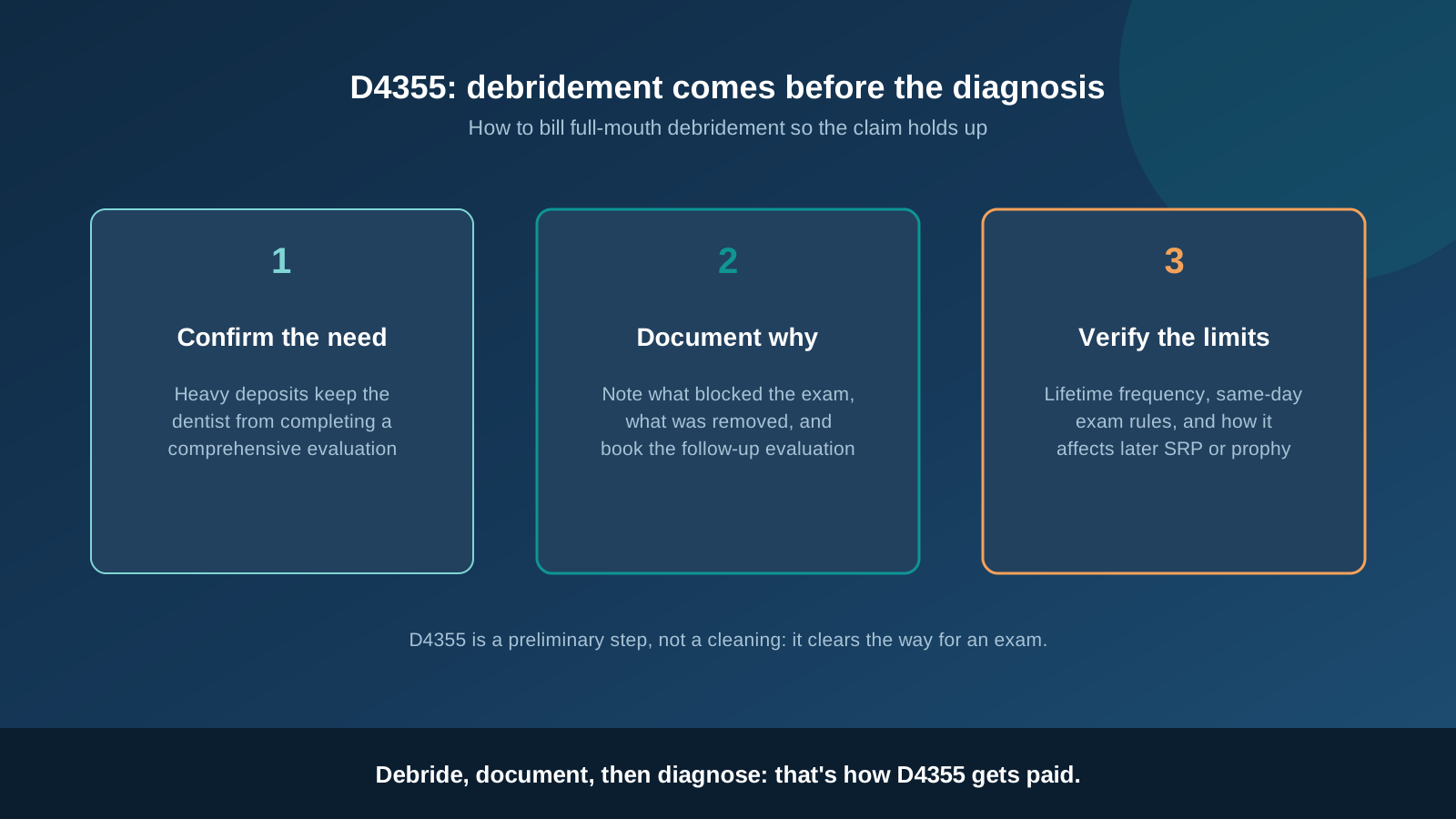
When D4355 is the right code
D4355 is full-mouth debridement to enable a comprehensive periodontal evaluation and diagnosis on a subsequent visit. In plain terms: the deposits are so heavy that the dentist cannot finish a proper exam until they are removed. That purpose shapes every billing rule around the code.
- It is preliminary, not definitive. D4355 clears the way for a diagnosis. It is not a cleaning and not periodontal therapy. If the patient turns out to have periodontitis, scaling and root planing follows at a later visit.
- No comprehensive exam that day. The CDT descriptor says D4355 is not completed on the same day as D0150, D0160 or D0180. A limited evaluation (D0140) may be allowed the same day by some payers, but if a comprehensive exam was possible, the debridement was not needed.
- Not with another hygiene code. Do not bill D4355 on the same date as a prophylaxis, D4346 or perio maintenance.
- Heavy is not the same as blocked. A patient with more calculus than usual but a mouth the dentist can still evaluate is a prophy or a D4346 case. D4355 is for when the deposits stop the exam.
What to document
Because D4355 is defined by what the dentist could not do, the chart has to show the obstacle, not just the work. Payers that review the code look for:
- A note that heavy plaque and calculus prevented a comprehensive evaluation, ideally with where and how much.
- Any radiographs taken, and a note if calculus obscured them.
- A description of what was removed and the instruments used.
- The follow-up appointment for the comprehensive or periodontal evaluation. A debridement with no evaluation scheduled looks like a mislabeled cleaning.
Intraoral photos are the strongest support you can send. A before photo and a one-line narrative attached to the claim heads off most requests for records.
How plans cover D4355
Coverage varies more than most practices expect, so verify before the patient leaves the first visit. Ask:
- What is the frequency limit? Many plans pay D4355 once per lifetime; others allow it once every 24 to 36 months. Check the patient's history with prior carriers when you can. See frequency limitations for how these limits are counted.
- Does it affect later hygiene? Some plans will not pay D4355 within a set period after a prophy or SRP, and a few count it against the cleaning frequency.
- What coverage level applies? Plans classify it as preventive, basic or periodontal, and that changes the patient's share and whether a deductible applies.
- Is there an alternate benefit? Some plans pay it at the D1110 allowance. In network, check your contract before billing the patient the difference.
Then give the patient a written estimate for the whole sequence: debridement today, evaluation next visit, and likely SRP or prophy after that. Patients who understand the plan up front are far more likely to return for the evaluation that makes the first visit worthwhile.
Bottom line
D4355 pays when it is used for what it is: a first step that removes deposits so a real diagnosis can follow. Bill it only when the deposits block a comprehensive exam, keep comprehensive evaluations and other hygiene codes off the same date, and document the obstacle along with the work. If your team wants help getting hygiene and perio codes paid the first time, our insurance billing services cover verification, coding review and claim follow-up.
Frequently asked questions
What is CDT code D4355?
D4355 is full-mouth debridement to enable a comprehensive periodontal evaluation and diagnosis on a subsequent visit. It is the gross removal of plaque and calculus that prevents the dentist from completing a full evaluation.
Can D4355 be billed on the same day as an exam?
The CDT descriptor says D4355 is not to be completed on the same day as a comprehensive oral evaluation (D0150), a detailed and extensive evaluation (D0160) or a comprehensive periodontal evaluation (D0180). Payer rules for a limited exam on the same day vary, so verify before billing.
Is D4355 the same as a deep cleaning?
No. D4355 is a preliminary procedure that removes deposits so the dentist can diagnose. Scaling and root planing (D4341 and D4342) is definitive treatment for periodontitis after a diagnosis has been made.
How often will insurance pay for D4355?
Many plans limit D4355 to once per lifetime or once every 24 to 36 months, and some will not pay it within a set period after a prophylaxis or SRP. Check the patient's history and plan limits before treatment.
Can D4355 and D1110 be billed together?
No. D4355 should not be billed with D1110, D4346 or D4910 on the same date. If deposits were light enough to finish a routine cleaning and complete exam in one visit, D4355 was not the right code.
Stop losing hygiene claims to coding rules
Dental Claim Professionals verifies hygiene benefits and reviews perio coding before claims go out.
Book a Free Consultation