
An inlay or onlay sits between a large filling and a full crown. It saves tooth structure, and with same-day CAD/CAM milling it has become routine in many offices. Insurance hasn't kept up. Inlays are often paid as if they were fillings, onlays get downgraded when the chart doesn't show cusp coverage, and a surface count that doesn't match the code sends the claim back. Here is how to code these restorations, what payers actually reimburse, and what to document so the claim pays the first time.
Choosing the code
CDT splits indirect restorations by three questions: does it cover a cusp, what is it made of, and how many surfaces does it involve?
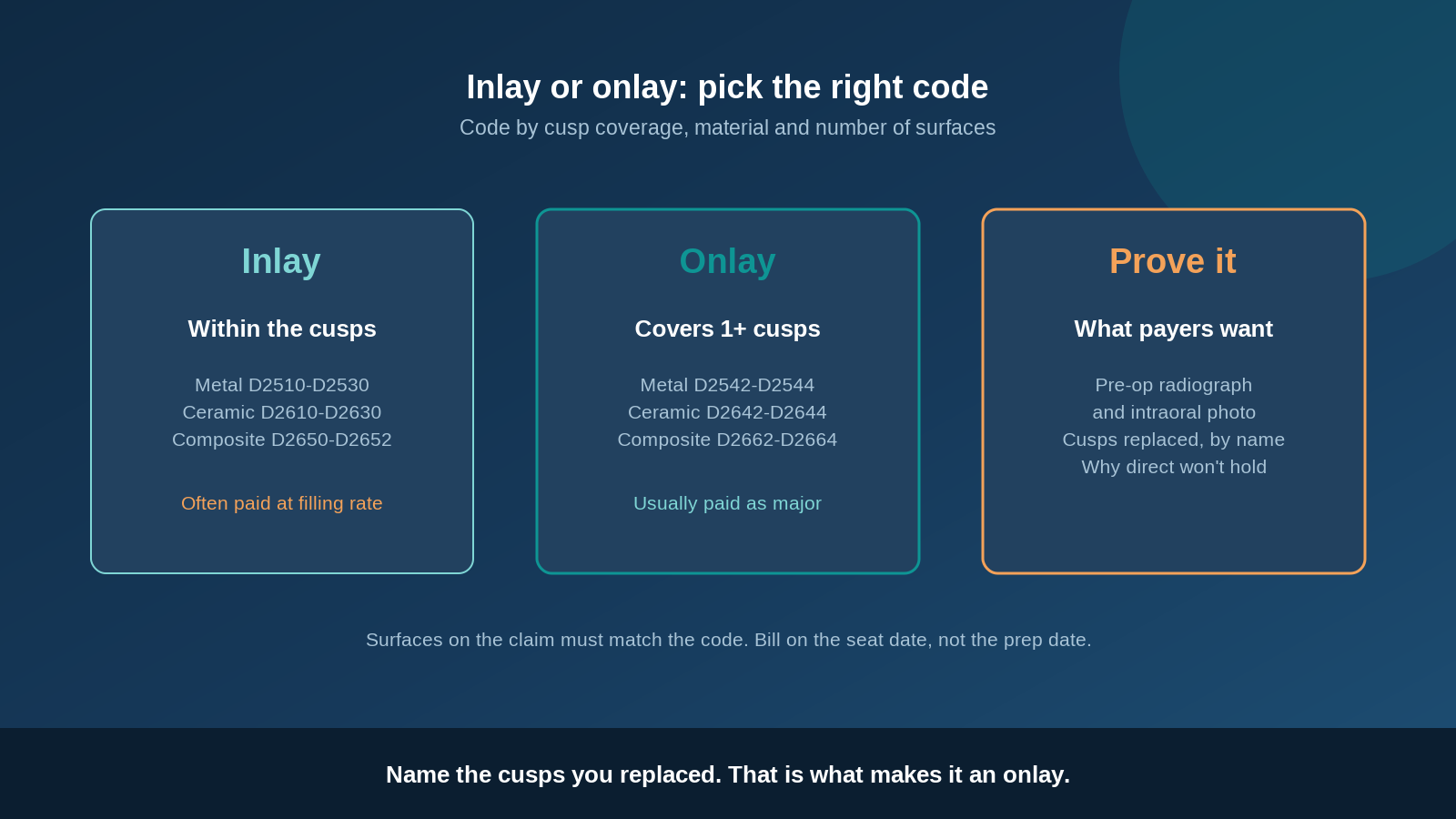
- Inlays restore within the cusps. Metallic D2510 (one surface), D2520 (two) and D2530 (three or more); porcelain/ceramic D2610, D2620 and D2630; resin-based composite D2650, D2651 and D2652.
- Onlays cover or replace one or more cusps. Metallic D2542 (two surfaces), D2543 (three) and D2544 (four or more); porcelain/ceramic D2642, D2643 and D2644; resin-based composite D2662, D2663 and D2664.
- Match the surfaces on the claim to the code. A D2643 with only two surfaces listed, or a D2630 listing four, is an easy rejection. Count the surfaces the restoration actually restores, not the ones the prep touched.
- Material follows the lab slip or mill. Lithium disilicate and zirconia are porcelain/ceramic. A milled composite block is resin-based composite, even if it looks like ceramic.
Bill on the seat date, when the final restoration is cemented or bonded. Billing at the prep appointment risks a recoupment if the patient never returns or their coverage ends before the seat.
How payers reimburse them
- Inlays are usually downgraded. Under the alternate benefit clause, most plans pay an inlay at the rate of an amalgam or composite with the same surfaces. The patient owes the difference, so put it in the estimate before treatment.
- Onlays are often treated like crowns. Many plans pay onlays as major services, at major coinsurance, with the same five-year replacement rule. Check frequency limits on the tooth, including any crown placed in the last five years.
- Onlays still get downgraded when the records show a large cavity but no cusp loss. The plan concludes a direct filling would have worked and pays that instead.
- Buildups are usually bundled. Most payers treat a core buildup under an inlay or onlay as part of the preparation. Billing D2950 with an onlay is a common, avoidable denial.
- Waiting periods and annual maximums apply. Major-service waiting periods often cover onlays, and a ceramic onlay can use a large share of a patient's annual maximum. For larger cases, a predetermination is worth sending.
What to document
- A pre-op radiograph and an intraoral photo showing the extent of decay, fracture or failing restoration.
- The cusps involved, by name: "MB and DB cusps fractured" says more than "large restoration."
- Why a direct restoration won't hold: remaining wall thickness, a cracked cusp, or a failed large filling.
- The material and the surfaces restored, matching the code and the lab slip or mill record.
A short narrative is often enough: "#30 MODB, fractured DB and MB cusps, recurrent decay under failing MOD amalgam; remaining walls under 1 mm; ceramic onlay D2644 seated 11/25/26."
Bottom line
Inlay and onlay claims get paid when the code matches cusp coverage, material and surface count, the claim goes out on the seat date, and the chart shows exactly which cusps were replaced and why a filling wasn't enough. Expect inlays to be paid at the filling rate and tell patients up front. If your office wants help getting indirect restorations paid without rework, our insurance billing services cover verification, coding review and appeals.
Frequently asked questions
What is the difference between an inlay and an onlay for billing?
An inlay restores tooth structure within the cusps and is coded D2510 to D2530 (metal), D2610 to D2630 (porcelain/ceramic) or D2650 to D2652 (resin-based composite) by number of surfaces. An onlay replaces or covers one or more cusps and is coded D2542 to D2544, D2642 to D2644 or D2662 to D2664. Cusp coverage, not size, decides which family applies.
Why did the plan pay my inlay at the filling rate?
Most plans have an alternate benefit clause that pays an inlay as the least costly adequate restoration, usually an amalgam or composite filling with the same number of surfaces. The patient owes the difference unless the plan or state rules limit balance billing on covered services.
Are onlays covered like crowns?
Often, yes. Many plans classify onlays as major restorative services, paid at the major coinsurance level with the same five-year replacement rule as crowns. Some plans still downgrade an onlay to a filling when records do not show cusp involvement.
When should an inlay or onlay be billed?
On the seat date, when the final restoration is cemented or bonded. Same-day CAD/CAM restorations are billed that day. Billing on the prep date risks a recoupment if the patient never returns or loses coverage before seating.
Can I bill a buildup with an onlay?
Usually not. Most payers consider a core buildup (D2950) part of an inlay or onlay preparation and deny it. Bill it only when the plan's policy allows it and records show the buildup was needed to retain the restoration.
Get restorative claims paid the first time
Dental Claim Professionals verifies benefits and reviews coding before claims go out.
Book a Free Consultation