
Night guards are one of the most requested appliances in general practice, and one of the least predictable to get paid. Some plans cover them once every few years, some exclude them outright, and others pay only when a TMD diagnosis is on file. A short routine at the front desk, covering the right code, the plan's limits and the clinical notes, keeps these claims paid and the patient estimate honest.
Choose the code by material and arch
Occlusal guard codes are defined by the appliance, so the lab prescription and the claim should match.
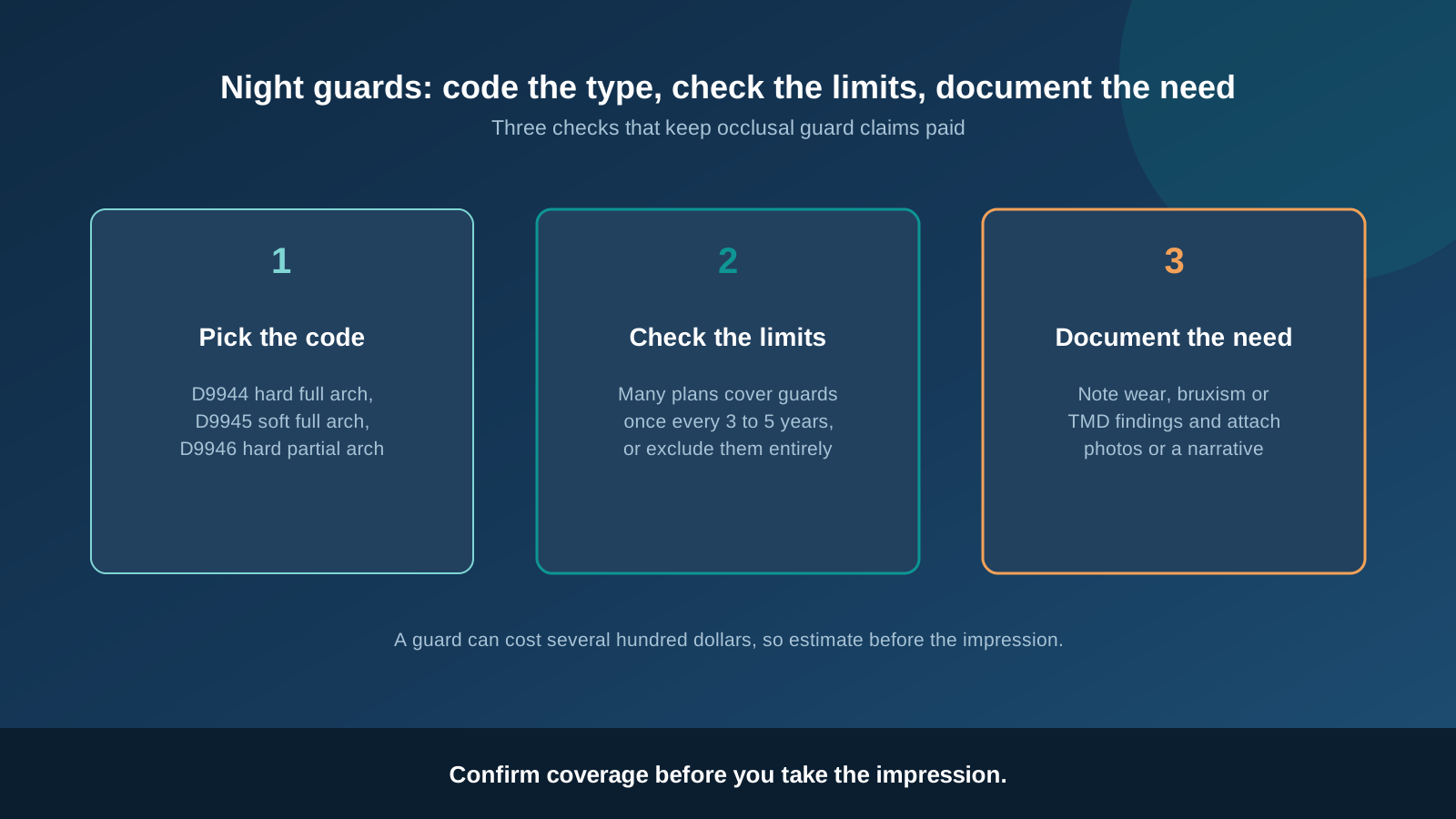
- D9944: occlusal guard, hard appliance, full arch. The most common night guard.
- D9945: occlusal guard, soft appliance, full arch. Plans sometimes pay less for soft appliances or exclude them.
- D9946: occlusal guard, hard appliance, partial arch. Use it only when the appliance does not cover the full arch.
- D9942 and D9943: reline and adjustment. D9942 repairs or relines an existing guard, and D9943 covers an adjustment.
Always report the arch, and do not use these codes for sleep apnea or orthodontic retainers, which have their own codes. A guard that is really a TMD appliance may need a different approach, so add a narrative when the case is unusual. Our guide to claim attachments and narratives explains what payers look for.
Verify coverage, frequency and the right payer
When you run eligibility verification, ask four questions: is the guard covered, at what percentage, how often, and is it limited to a diagnosis such as TMD or bruxism. Most plans that cover guards allow one every three to five years, and many treat them as a major service, so a waiting period may apply. The frequency limitation usually counts from the last guard, including one made at another office.
If the dental plan excludes the appliance and the patient has a documented TMD diagnosis, a medical plan may consider it. That path needs medical diagnosis codes and often a letter of medical necessity, as described in our post on medical cross-coding. Never assume the denial is final until you have checked both policies.
Document the need and estimate the patient portion
Payers that cover guards want evidence. Record wear facets, fractures, muscle tenderness, limited opening or reported clenching, and attach intraoral photos when the plan requires them. Report the delivery date as the date of service so a patient who never returns for the appliance does not create a recoupment.
A guard can cost several hundred dollars and may count against the annual maximum. Give a written estimate before the impression, explain that a denial leaves the patient responsible, and collect the lab portion up front where your policy allows. For unclear cases, a predetermination settles the question before any work is done.
Bottom line
Occlusal guard billing rewards preparation: match the code to the appliance and arch, verify coverage and frequency before the impression, and document the clinical need while the patient is still in the chair. If your team would rather not chase these claims, our insurance billing services handle verification, submission and follow-up.
Frequently asked questions
Which code do I use for a night guard?
Use D9944 for a hard full-arch occlusal guard, D9945 for a soft full-arch guard and D9946 for a hard partial-arch guard. Report the arch and choose the code that matches the appliance material.
Does dental insurance cover night guards?
Many plans cover an occlusal guard once every three to five years, often as a major service with a waiting period, but some exclude it or cover it only for diagnosed TMD. Verify before the impression.
Should I bill dental or medical insurance for a guard?
Start with the dental plan. If it excludes guards and the patient has a TMD diagnosis, a medical plan may consider the appliance, which requires the right diagnosis codes and often a physician or dentist narrative.
What date of service do I report for an occlusal guard?
Report the delivery date, not the impression date, so the claim reflects the appliance actually placed.
How do I bill a reline or adjustment of a night guard?
Use D9942 to reline or rebase an existing guard and D9943 for an adjustment. Many plans bundle early adjustments into the original fee, so check the window before billing.
Get paid for every appliance
Dental Claim Professionals verifies benefits up front and follows up on every denied claim.
Book a Free Consultation