
Periodontal surgery is one of the most expensive procedures a general or periodontal practice bills, and one of the most scrutinized. Payers want proof that non-surgical therapy was tried first and didn't work, and they look closely at how many teeth were treated in each quadrant. Get the code or the paper trail wrong and a four-quadrant case can turn into four denials. Here is how to pick between flap and osseous codes, the rules payers apply, and what to document so these claims pay.
Choosing the code
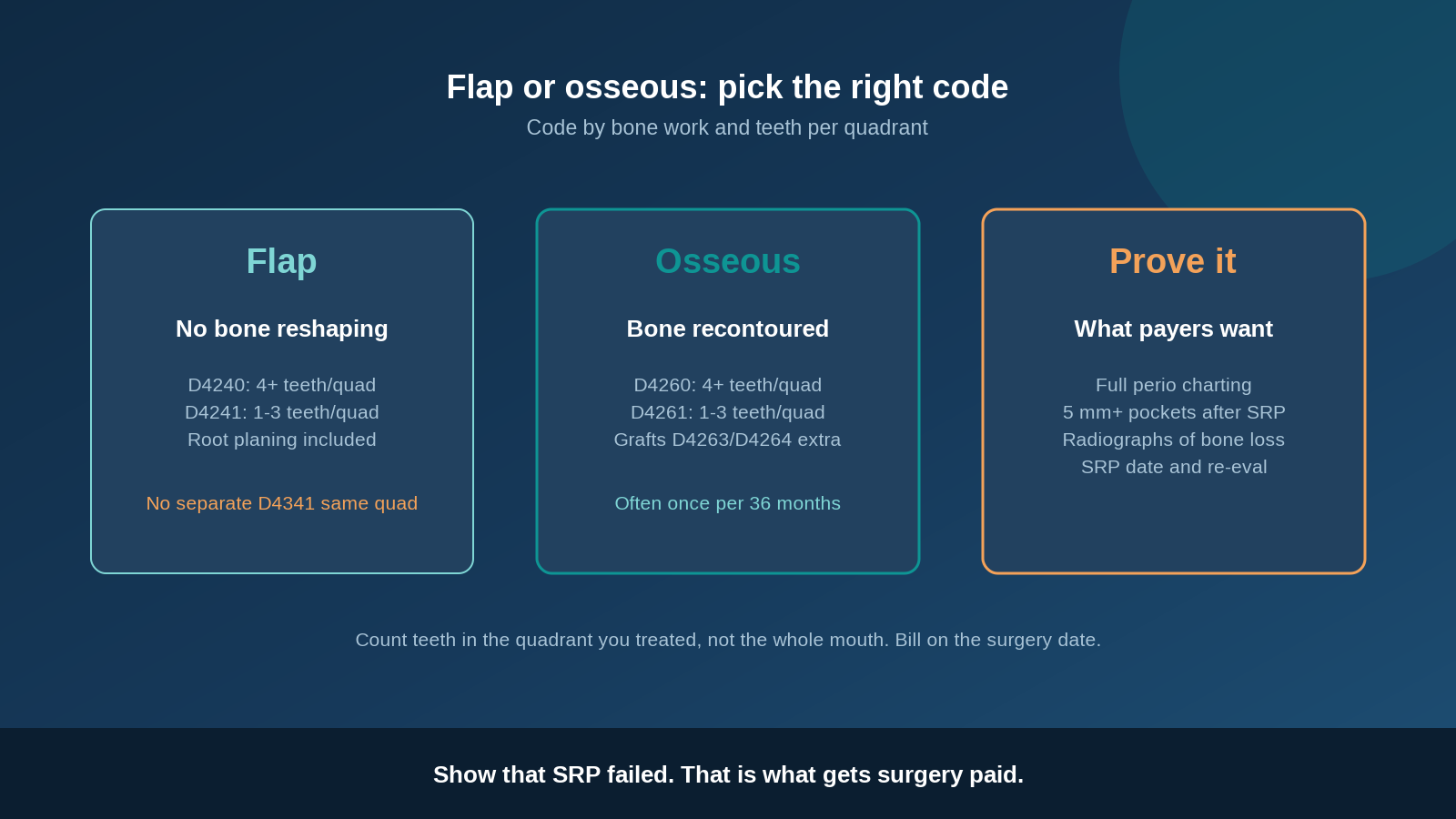
CDT separates periodontal flap surgery by two questions: was bone reshaped, and how many teeth were treated in the quadrant?
- D4240 and D4241, gingival flap procedure including root planing. A flap is raised for access and debridement, but bone is not recontoured. D4240 is four or more contiguous teeth or tooth-bounded spaces per quadrant; D4241 is one to three.
- D4260 and D4261, osseous surgery including flap entry and closure. Use these when bone is reshaped to eliminate craters or defects. D4260 is four or more teeth per quadrant; D4261 is one to three.
- Count per quadrant, not per mouth. Two teeth in the upper right and two in the upper left are two D4261s, not one D4260. Each quadrant gets its own line with its own area of the oral cavity.
- Add-on procedures are separate lines. Bone replacement grafts are D4263 (first site in a quadrant) and D4264 (each additional site); guided tissue regeneration is D4266 or D4267. Don't confuse these with crown lengthening (D4249), which is done for restorative access, not disease.
Bill each quadrant on the date it was treated. When quadrants are done weeks apart, a quadrant that falls into a new benefit year draws from the new annual maximum, which can help patients finishing a case in January.
The rules payers apply
- SRP must come first. Most plans require scaling and root planing on the quadrant, then a re-evaluation (typically four to six weeks later) showing pockets that didn't resolve. Surgery without a prior SRP date is the most common denial.
- Pocket depth thresholds. Many payers look for probing depths of 5 mm or more after SRP, with bleeding or bone loss to match. Pockets of 4 mm rarely support surgery.
- No same-day SRP on the same quadrant. Root planing is built into D4240 and D4241, and same-day D4341 with D4260 on that quadrant is treated as unbundling.
- Frequency limits. Surgery on the same quadrant is commonly limited to once every 36 months. Check frequency history before scheduling, including surgery done at another office.
- Category and waiting periods vary. Some plans pay periodontal surgery as basic, others as major with a waiting period. A predetermination is worth sending on any multi-quadrant case.
What to document
- Full periodontal charting from before SRP and from the re-evaluation, showing six-point pocket depths, bleeding, recession and mobility.
- Current radiographs, ideally a full-mouth series or bitewings plus periapicals, showing horizontal or vertical bone loss in the treated quadrant.
- The SRP dates by quadrant and the re-evaluation result.
- The operative note: teeth treated, whether bone was recontoured, and any graft or membrane placed.
A short narrative ties it together: "UR quadrant, teeth #2-#5. SRP 9/15/26; re-eval 10/27/26 shows persistent 6-7 mm pockets with BOP and angular bone loss on #3 and #4. Full-thickness flap with osseous recontouring, D4260, 11/26/26."
Bottom line
Periodontal surgery claims get paid when the code matches the bone work and the tooth count in each quadrant, and when the record shows SRP was done, re-evaluated and failed. Keep grafts on their own lines, never bill same-day SRP on the surgical quadrant, and verify frequency and category before the patient is in the chair. After surgery, move the patient to periodontal maintenance (D4910). If your office wants help getting perio claims paid without rework, our insurance billing services cover verification, coding review and appeals.
Frequently asked questions
What is the difference between D4240 and D4260?
D4240 is a gingival flap procedure that includes root planing but no bone recontouring. D4260 is osseous surgery, where the flap is raised and the bone is reshaped to eliminate defects. Both are per quadrant for four or more contiguous teeth or tooth-bounded spaces; D4241 and D4261 cover one to three teeth in a quadrant.
Why was osseous surgery denied?
The most common reasons are no record of prior scaling and root planing, no current periodontal charting showing pockets of 5 mm or more after SRP, radiographs that do not show bone loss, or a repeat surgery on the same quadrant within the plan's frequency window, often 36 months.
Can I bill scaling and root planing on the same day as periodontal surgery?
Not on the same quadrant. Root planing is included in D4240 and D4241, and payers treat same-day D4341 or D4342 with D4260 or D4261 in that quadrant as part of the surgery. SRP should be completed and re-evaluated, typically four to six weeks earlier.
Are bone grafts billed separately from osseous surgery?
Yes. Bone replacement grafts are reported with D4263 (first site in a quadrant) and D4264 (each additional site), and guided tissue regeneration membranes with D4266 or D4267. Many plans limit or deny them, so verify coverage and send a predetermination.
Is periodontal surgery covered as basic or major?
It varies by plan. Some plans place periodontal surgery in a basic or periodontics category at 70 to 80 percent, while others treat it as major at 50 percent with a waiting period. Verify the category and frequency before scheduling.
Get periodontal claims paid the first time
Dental Claim Professionals verifies benefits and reviews coding before claims go out.
Book a Free Consultation