
A patient fractures a premolar below the gumline. Before it can be crowned, the dentist or periodontist needs to expose more sound tooth, so they raise a flap, reshape the bone and let it heal. That procedure is crown lengthening, D4249. It is one of the most frequently denied periodontal codes. The trouble is rarely clinical. The usual causes are the wrong code, a same-day date of service with the crown prep, or a claim with no explanation of why the tooth needed it.
D4249 or a gingivectomy code?
Before anything else, confirm what was actually done. Three codes get confused here:
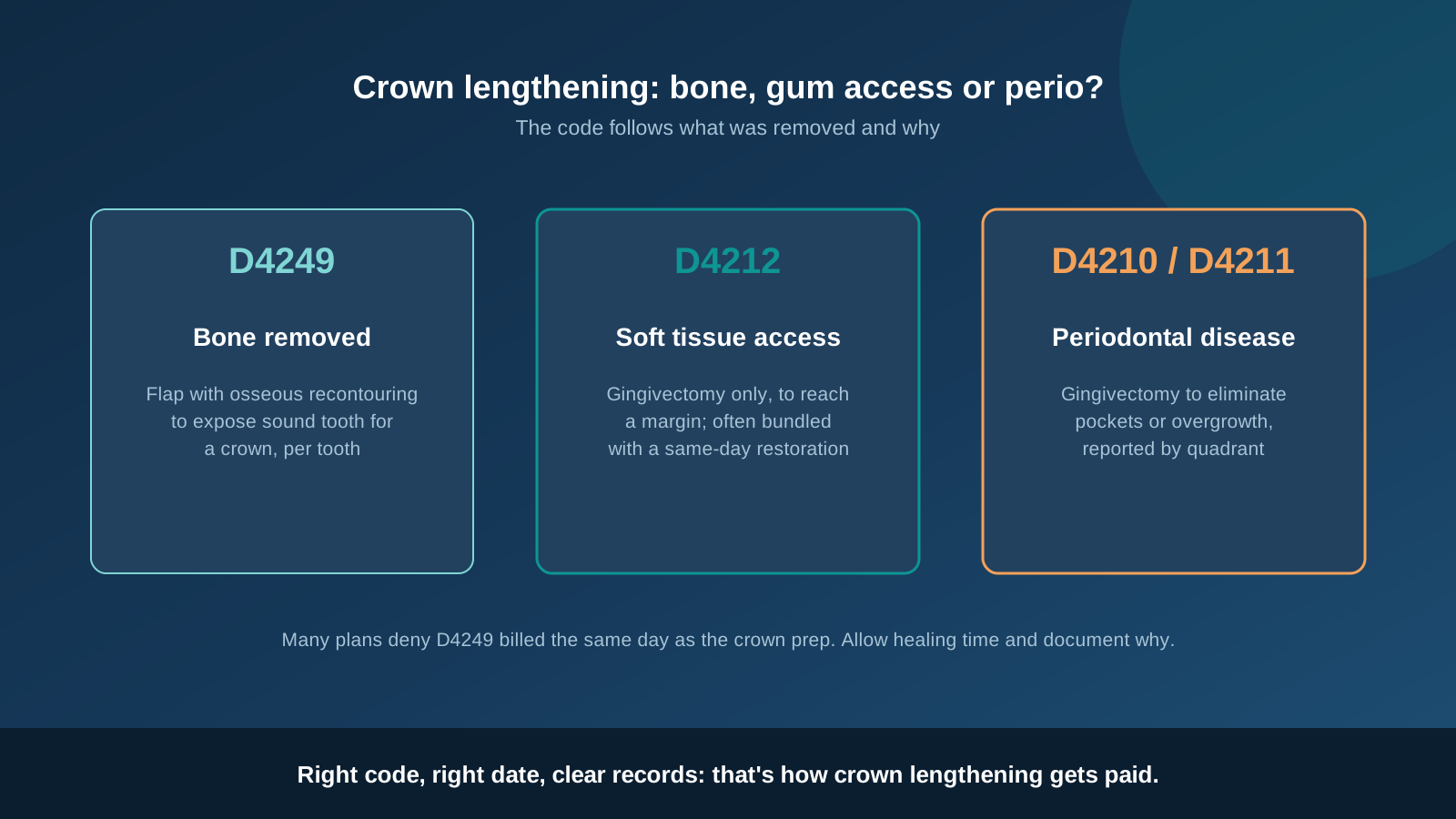
- D4249, clinical crown lengthening, hard tissue. A flap is raised and bone is removed or recontoured to expose sound tooth structure for a restoration. It is reported per tooth, in a healthy periodontium, and the clinical notes should say that bone was involved.
- D4212, gingivectomy or gingivoplasty to allow access for a restorative procedure. Soft tissue only, per tooth, typically done to reach a subgingival margin. When it happens at the same visit as the restoration, many payers treat it as part of the restoration, so expect it to be bundled.
- D4210 and D4211, gingivectomy to treat disease. These are for pocket elimination or gingival overgrowth, reported by quadrant (four or more teeth, or one to three teeth). They are perio therapy codes, not restorative access codes, and need charting to support them.
If no bone was removed, D4249 is the wrong code, and an audit or recoupment may follow. If bone was removed, do not downcode to D4212 to make the claim look smaller. That leaves earned revenue on the table.
Timing: why same-day claims get denied
Most payers expect crown lengthening to be a separate procedure from the crown. When D4249 and a crown or buildup show the same date of service, many plans deny the crown lengthening as part of the restoration, or ask for records to prove it was a distinct surgery. Clinically, tissue usually needs several weeks to heal before the final preparation and impression anyway.
- Schedule and bill on separate dates whenever the treatment plan allows.
- Check plan rules on spacing. Some plans set a minimum interval between D4249 and the final restoration, or limit crown lengthening on a tooth that already had surgery.
- Confirm the crown will be covered. Some plans pay D4249 only when the restoration it supports is also a covered benefit. If the crown falls under a frequency limit or waiting period, the crown lengthening may be denied too.
For multi-step cases, a predetermination covering both D4249 and the crown gives the patient a clear estimate. With the plan year ending, it also shows whether the remaining annual maximum can cover the surgery now and the crown in January.
What to document
Crown lengthening claims are routinely reviewed, so send the records with the first submission instead of waiting for a request:
- A preoperative radiograph showing the fracture, decay or margin extending toward the bone.
- An intraoral photo, if available, and current periodontal charting for the tooth.
- The tooth number, the planned restoration and confirmation that bone was removed or recontoured.
A short narrative carries most of the weight: "#13 fractured 2 mm subgingivally on the buccal; insufficient sound tooth structure for crown margin. Flap raised and osseous recontouring performed to establish biologic width. Crown planned after healing."
Bottom line
Crown lengthening gets paid when the code matches the procedure, the surgery and the crown are on separate dates, and the claim explains why the tooth needed it. Use D4249 only when bone was involved, verify that both the surgery and the crown are covered, and attach the radiograph and narrative up front. If your team wants a second set of eyes on perio and restorative claims, our insurance billing services cover verification, coding review and appeals.
Frequently asked questions
What is CDT code D4249?
D4249 is clinical crown lengthening, hard tissue. It is a surgical procedure, reported per tooth, in which a flap is raised and bone is removed or recontoured to expose more sound tooth structure so a restoration can be placed on a healthy foundation.
Can crown lengthening be billed the same day as a crown prep?
It can be reported, but many payers deny or downgrade D4249 when it is billed on the same date as the crown preparation, or treat it as part of the crown. Most clinicians allow several weeks of healing before the final preparation anyway, so separate dates of service usually reflect both good care and clean billing.
What is the difference between D4249 and D4212?
D4249 involves removing or reshaping bone. D4212 is a gingivectomy or gingivoplasty performed only to allow access for a restorative procedure, with soft tissue removed and no bone work. D4212 is frequently bundled into a same-day restoration.
Does dental insurance cover crown lengthening?
Many plans cover D4249 as a periodontal or major service when it is needed to restore the tooth, subject to coinsurance, deductibles, waiting periods and the annual maximum. Some exclude it or pay it only when the related crown is also a covered benefit, so verify before treatment.
What documentation do payers want for crown lengthening?
Payers usually ask for a preoperative radiograph, the tooth number, the planned restoration and a narrative explaining why there is not enough sound tooth structure, such as a fracture or decay extending below the gumline. Intraoral photos and periodontal charting strengthen the claim.
Stop losing crown lengthening claims to avoidable denials
Dental Claim Professionals verifies perio and restorative benefits and reviews coding before claims go out.
Book a Free Consultation