
A patient loses a lower molar, and the dentist places graft material in the socket so there will be enough bone for an implant in four months. Clinically it is routine. On the claim it is easy to get wrong. Bone graft codes depend on where the graft goes and what else happened that day, the membrane has its own code, and coverage ranges from full benefit to flat exclusion. Bill the wrong code, or skip the benefit check, and a $400 to $900 procedure lands on the patient's statement as a surprise.
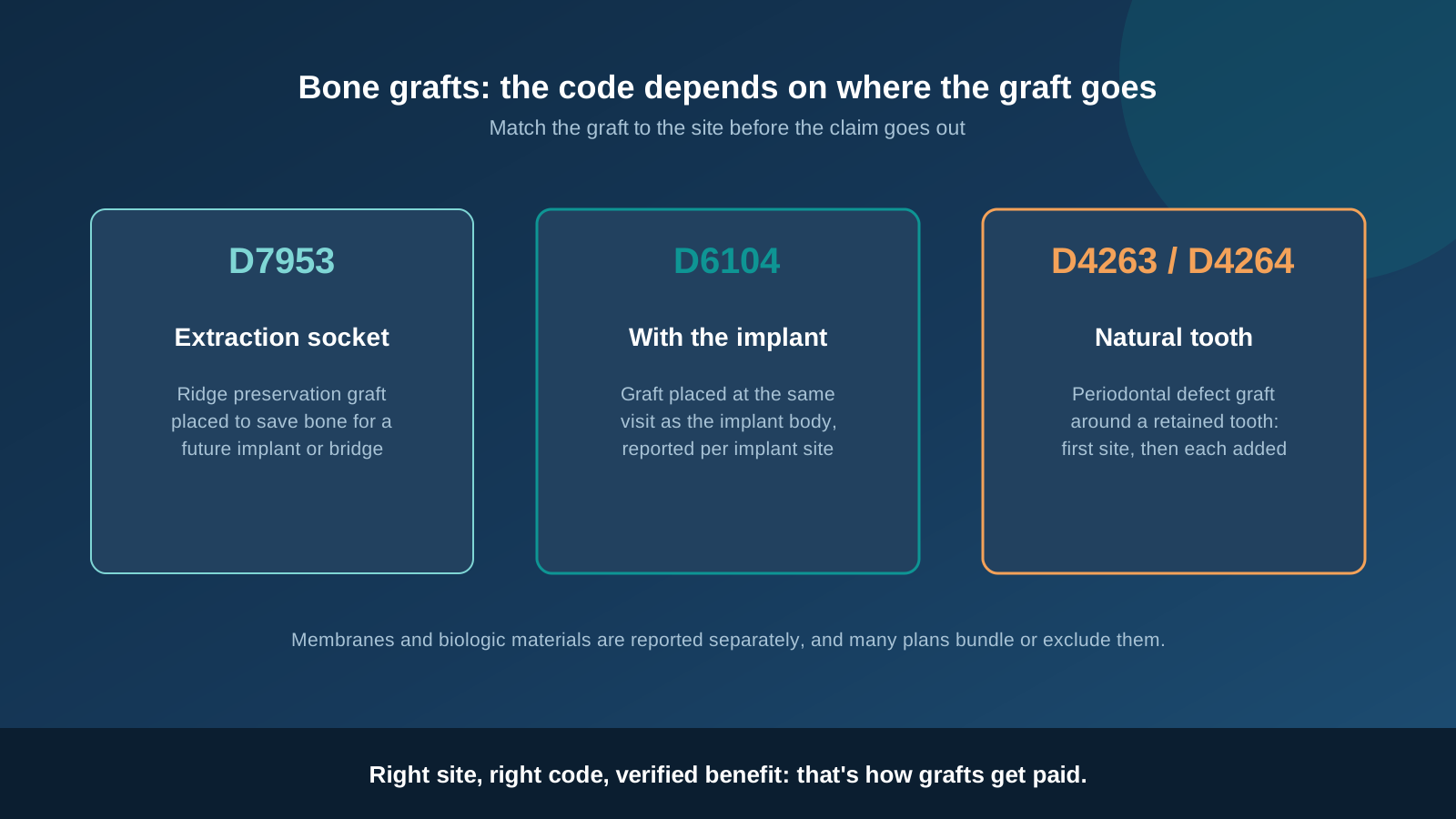
Choosing the right graft code
The first question is always: where did the graft go, and was anything placed with it?
- D7953, ridge preservation. Bone replacement graft for ridge preservation, per site. This is the usual socket preservation code, placed after an extraction to hold bone for a future implant, bridge or denture. Report the extraction and D7953 separately, each with the tooth number.
- D6104, graft at implant placement. When the graft goes in at the same visit as the implant body, D6104 is generally the right code rather than D7953. It belongs with the rest of the implant claim, and plans that exclude implants often exclude it too.
- D4263 and D4264, natural teeth. Bone replacement graft for a periodontal defect around a retained natural tooth: D4263 for the first site in a quadrant, D4264 for each additional site. These are periodontal codes, not surgical ones, and they usually need perio charting to back them up.
- D7950, larger ridge augmentation. Grafts to rebuild a deficient ridge, rather than preserve a fresh socket, may fall under D7950, which is by report. Expect a narrative and records with every claim.
Barrier membranes are reported on their own line: D7956 or D7957 in an edentulous site, D6106 or D6107 around an implant, and D4266 or D4267 around a natural tooth. Biologic materials such as growth factors use D4265. Report what was actually placed, but expect some payers to bundle the membrane into the graft.
How plans cover bone grafts
Graft coverage varies more than almost any other surgical benefit, so verify it specifically. Do not assume it follows extraction coverage. Ask:
- Are grafts covered at all? Many plans exclude D7953 entirely, or cover it only when the plan also covers implants.
- Which category applies? Grafts may be paid as basic oral surgery, major services or periodontics, which changes the coinsurance, deductible and any waiting period.
- Is there a missing tooth clause? If the tooth was lost before coverage began, a missing tooth clause can deny the graft along with the implant.
- Is the membrane covered separately? Get the answer for each code you plan to report.
- Could medical pay? Grafts after trauma or for pathology may qualify under the patient's medical plan. See medical cross-coding.
For larger cases, a predetermination removes the guesswork, and with the year ending, it also shows how much of the annual maximum is left for a graft now and an implant in the new plan year.
What to document
Grafts are reviewed often, and the records decide the claim. Include:
- A preoperative radiograph showing the site or defect.
- The tooth number or site, the reason for the graft, and the planned restoration.
- The graft material (autograft, allograft, xenograft or synthetic) and any membrane or biologic used.
- For D4263 and D4264, current perio charting with pocket depths and the defect.
A two-sentence narrative such as "Extraction #30 due to nonrestorable fracture; ridge preservation graft placed to maintain bone for implant" prevents most requests for more information.
Bottom line
Bone grafts get paid when the code matches the site, the membrane is reported on its own line, and the benefit was checked before treatment. Use D7953 for socket preservation, D6104 when the implant goes in the same day, and D4263 or D4264 around natural teeth, then give the patient a written estimate that reflects any exclusion. If your team wants help with surgical and implant claims, our insurance billing services cover verification, coding review and claim follow-up.
Frequently asked questions
What CDT code is used for socket preservation?
D7953 is bone replacement graft for ridge preservation, reported per site. It is typically placed in an extraction socket to preserve bone for a future implant or other restoration.
What is the difference between D7953 and D6104?
D7953 is a ridge preservation graft placed in a site without an implant, often at the time of extraction. D6104 is a bone graft placed at the same time as the implant body. If the graft and implant go in at the same visit, D6104 is generally the correct code.
Does dental insurance cover bone grafts?
It depends on the plan. Some plans cover grafts as oral surgery or periodontics, some cover them only when implants are a covered benefit, and many exclude them entirely. Verify coverage, frequency limits and any missing tooth clause before treatment.
Can a membrane be billed with a bone graft?
A barrier membrane is reported with its own code, such as D7956 or D7957 for an edentulous site, D6106 or D6107 around an implant, or D4266 or D4267 around a natural tooth. Many plans bundle the membrane into the graft or exclude it, so check before telling the patient it is covered.
What documentation do payers want for a bone graft claim?
Payers usually want a preoperative radiograph, the tooth number or site, the reason for the graft, the graft material used, and the planned restoration. A short narrative explaining why the site needed grafting resolves most requests for records.
Get surgical and implant claims paid the first time
Dental Claim Professionals verifies graft and implant benefits and reviews coding before claims go out.
Book a Free Consultation